
Estimated reading time: 17 minutes
Maybe you’ve read about ETFs and stock investing for months. But you still haven’t made your first investment.
The usual reasons sound reasonable: “I’m not rich enough yet,” or “I still need to build my emergency fund.” Both are valid. Money set aside for bills should never be invested just because an article made it sound exciting.
But here’s a different perspective, after seven years of investing with my own money and conversations with tens of thousands of beginners: if the emergency fund were the real obstacle, most people would have started the month after it was done. Many don’t.
The real obstacle is usually fear. Investing feels like one big decision that could go wrong. The wrong ETF. The wrong entry point. RM10,000 of hard-earned savings becoming RM7,000 the following month, with nobody to blame but yourself.
That happens. It still happens to experienced investors, and it will happen to almost anyone who stays in the market long enough. So the goal of this guide is simple: make the first decision small enough that being wrong doesn’t really hurt, while still getting the ball rolling.
TABLE OF CONTENTS
Start With Your Investment Amount
Before choosing anything, answer one question: which part of your money can you leave invested without affecting the things you need to pay for?
The key phrase is leave invested. This is money you won’t pull out when your car needs new tyres or an unexpected bill arrives.
For some people, that number is RM300 a month. For others, RM1,000. And for some, right now, it’s zero. That’s completely fine. It simply means the first job is the budget: build at least three months of living expenses first, then start investing at a level that feels comfortable.
There is no minimum where investing suddenly becomes “worth it.” The amount has to fit your life. As a rough reference, on a RM4,500 salary, setting aside around RM300 a month for investing is a reasonable starting point. More is better, and the amount can always be adjusted as your situation changes.
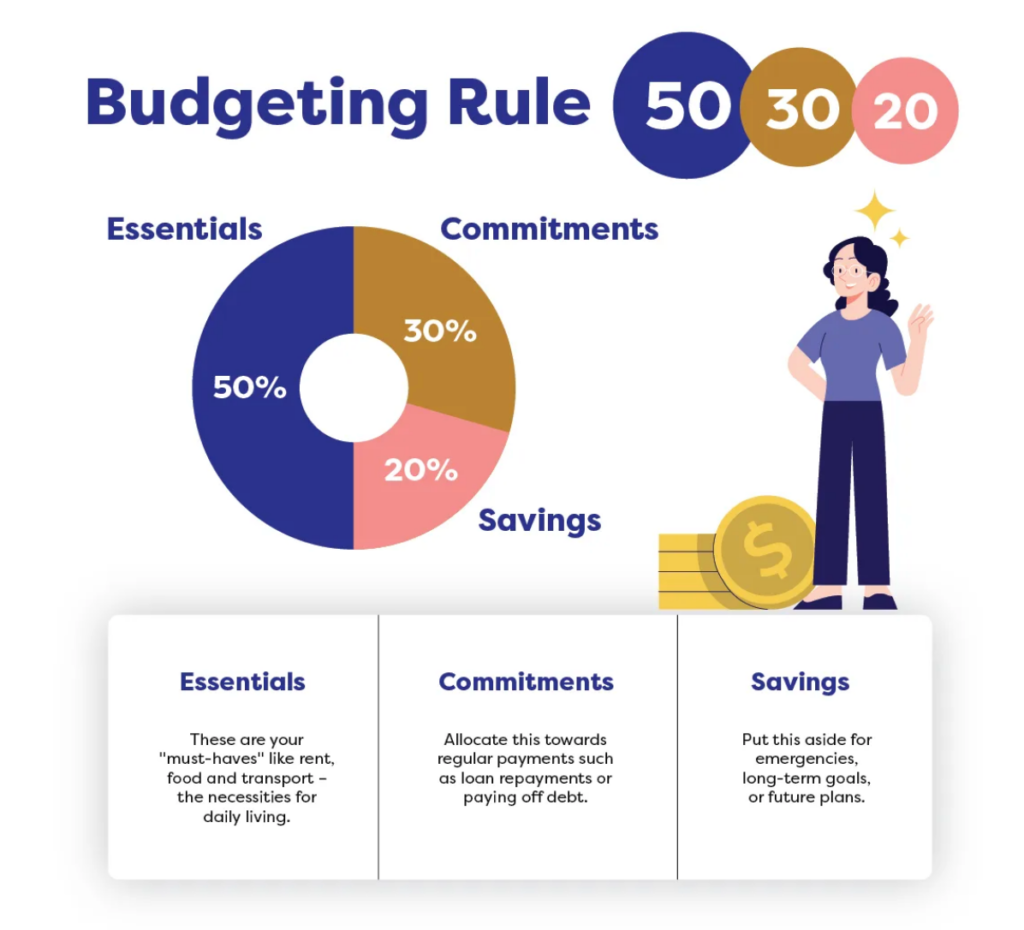
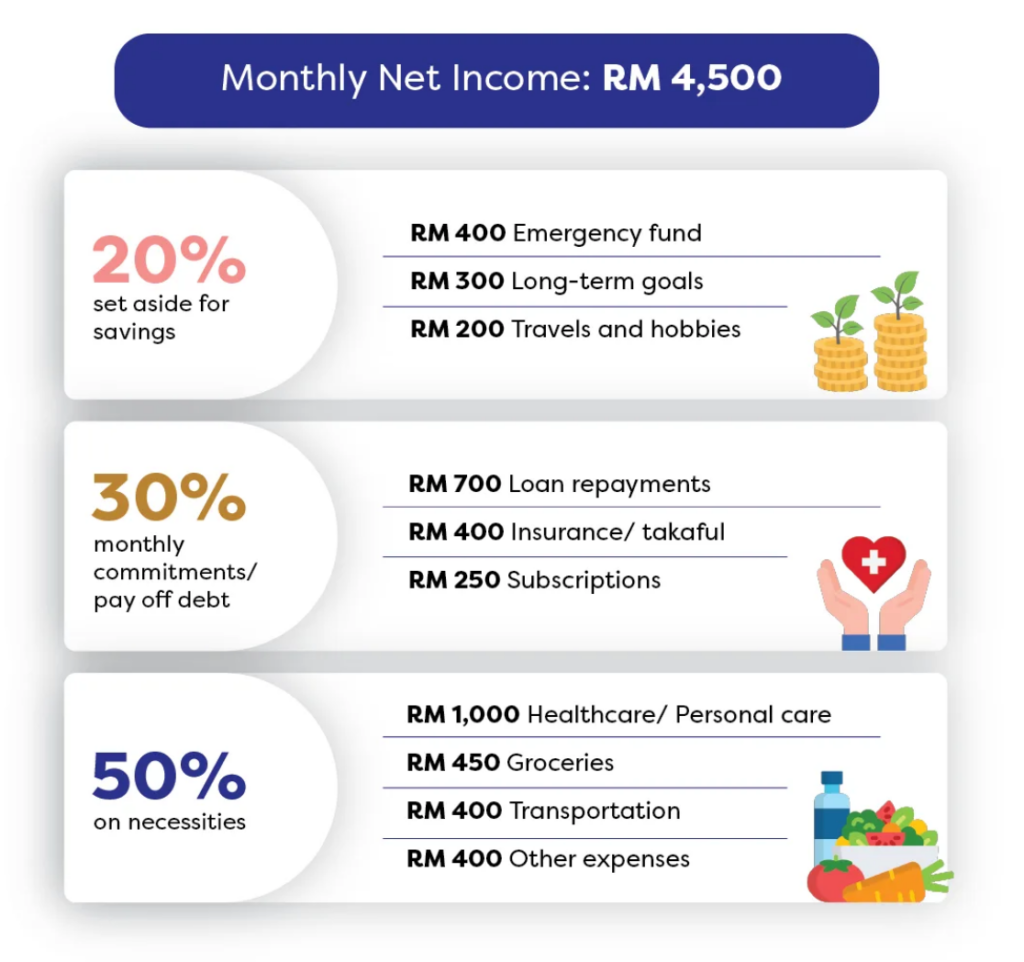
Why start here? Because once the amount is fixed, every decision after it gets smaller. You’re no longer asking “should I invest?” but “where should this RM300 go?”
Checklist #1: What’s Actually Inside The ETF?
This guide uses the S&P 500 as the example, because it’s where most beginners land first, and for good reason. It’s one of the most popular investment benchmarks in the world. The same checklist, though, applies to any ETF you’re considering.
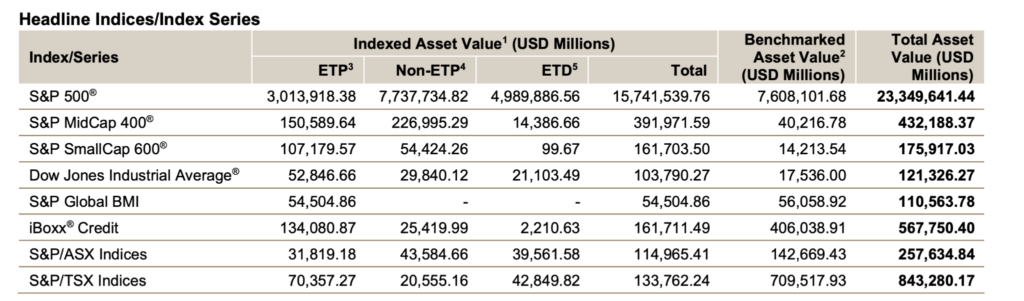
The S&P 500 is an index: a basket of roughly 500 large American companies. An ETF that tracks it lets you buy a tiny slice of all of them at once.
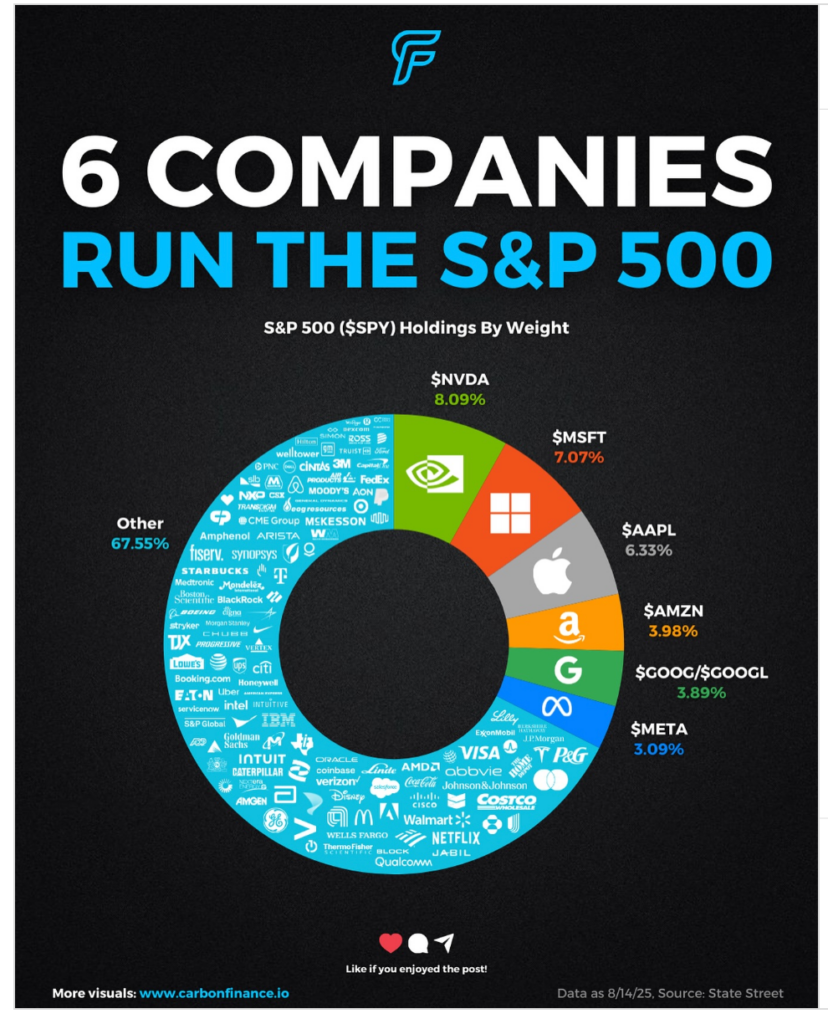
That creates concentration. The top 10 companies make up around 38% of the index, meaning nearly RM4 of every RM10 you invest goes into just 10 names. The same pattern shows up at sector level, where technology is the largest sector by a wide margin.
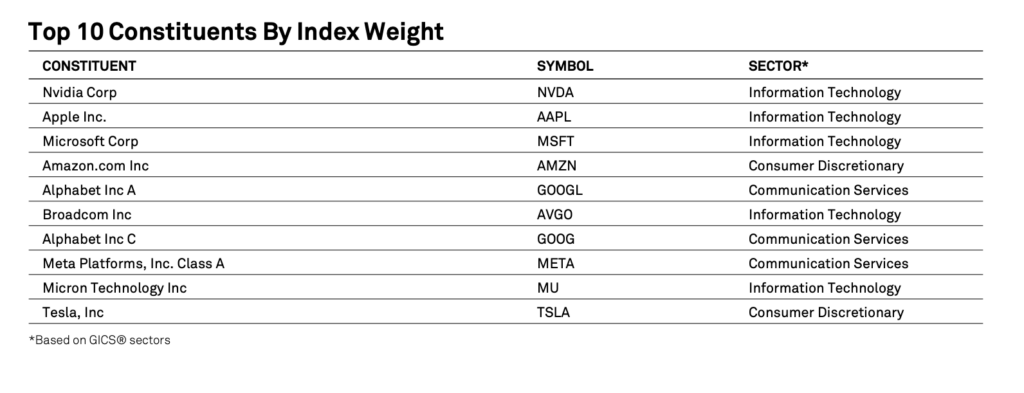
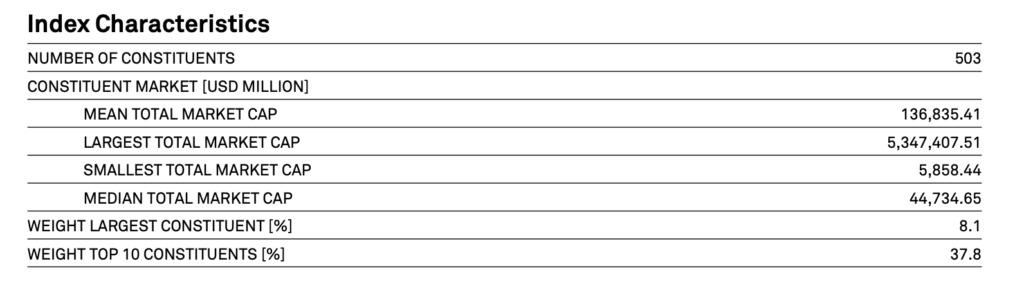
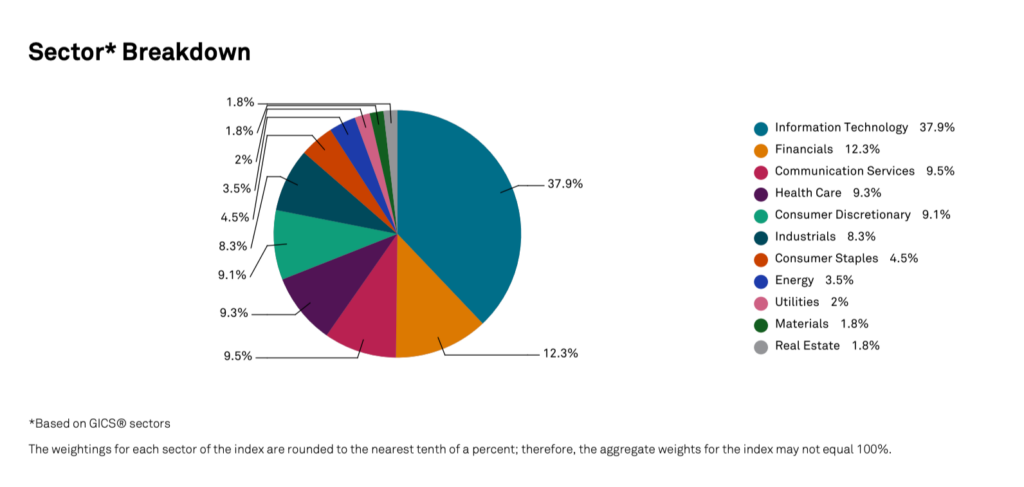
So yes, an S&P 500 ETF gives you real diversification. 500 companies is far more spread out than picking three stocks yourself. The catch is that when the largest tech companies have a bad quarter, the whole fund moves with them.
A clear example came on 24 July 2024. Just two companies, Alphabet and Tesla, reported disappointing earnings. Their weight alone was enough to pull the S&P 500 down 2.3% in a single day, while the more tech-heavy Nasdaq fell 3.6%.
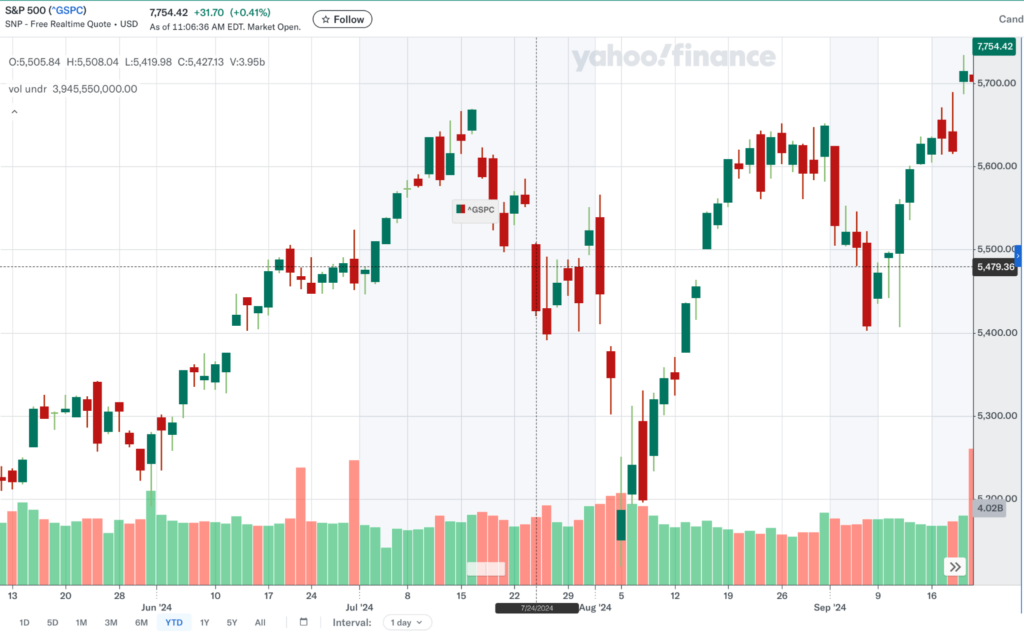
Knowing this in advance matters. When the index drops, it doesn’t mean you picked wrong. Zoom out and look at how the index has behaved over the long run: volatile in the short term, but the long-term record speaks for itself. Understanding this one point is often the difference between holding on and panic selling at the bottom.
Checklist #2: What Does It Cost to Hold?
The second thing to check is what the fund costs you every single year.
An ETF is a managed fund. Someone has to run it: track the index, and buy or sell when companies enter or leave the list. That team is paid out of the fund, so a fee is normal.
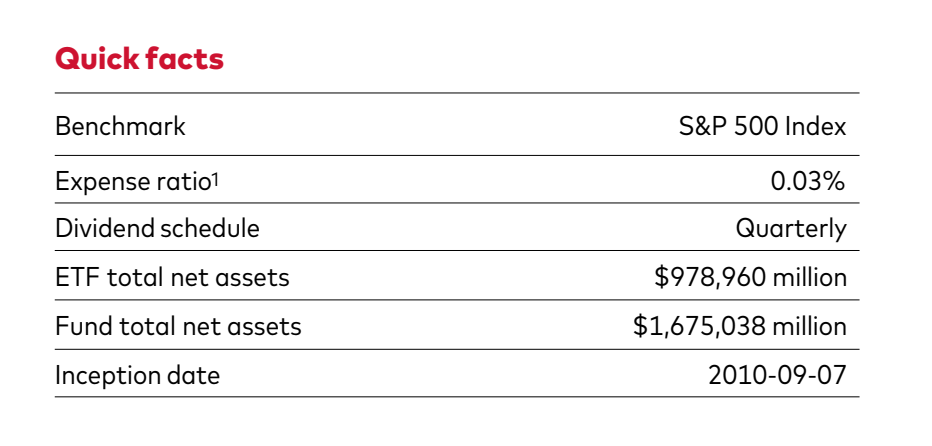
Funds tracking the exact same index often charge very different fees. All four below track the S&P 500, yet SPY charges nearly five times what SPLG does:
| ETF | SPLG | VOO | IVV | SPY |
| Expense Ratio | 0.02% | 0.03% | 0.03% | 0.095% |
If you’re essentially buying the same thing, there’s little reason to pay more for it.
Compare that with a typical unit trust in Malaysia. Investors usually pay an upfront sales charge of around 1.5% to 5% before a single ringgit is invested, then an annual management fee of roughly 1% to 2%. On RM10,000, that’s a few hundred ringgit gone on day one, then RM100 to RM200 every year. VOO, by comparison, costs about RM3 a year on the same amount.
One reason ETF costs go unnoticed is that there’s no bill. The expense ratio is deducted from the fund automatically, before you ever see the price. That’s exactly why it quietly eats into returns for people who never check.
Before buying, pull up the fund’s factsheet and find the expense ratio. That’s the number you’ll be paying every year for as long as you hold.
Checklist #3: Three Checkpoints for Malaysian Investors
Investing in foreign markets from Malaysia adds three considerations that local guides often skip.
1. The exchange rate. Buying US assets means holding US dollars. Your return in ringgit now has two parts: what the fund does, and what the dollar does against the ringgit.
| Portfolio Amount in USD | Exchange rate | Portfolio Amount in RM |
| USD 100 | USD 1 = RM 4.00 | RM 400 |
| USD 110 | USD 1 = RM 3.60 | RM 396 |
In this example, the fund gained 10%, but a stronger ringgit wiped out the gain. The reverse is also true: if the ringgit weakens, your ringgit returns get a boost. So before reacting to a number in your app, check what actually moved. Sometimes it’s just the currency.
2. Withholding tax on dividends. The US withholds 30% of dividends paid to Malaysian investors, because Malaysia does not have a tax treaty with the US. When a fund pays a USD 1 dividend, you receive USD 0.70. The tax is deducted before it reaches you.
3. US estate tax. This is the one most people don’t know about. If you pass away holding US-listed shares, the US can tax your US assets before your family receives them. For non-resident investors, anything above USD 60,000 can be taxed at rates of up to 40%. Nobody enjoys thinking about this at the start, but if you plan to hold for 20 or 30 years, it’s worth one proper conversation with an estate planning professional.
“What If I Buy and It Drops?”
Once the checklist is done, a new worry tends to appear: the price.
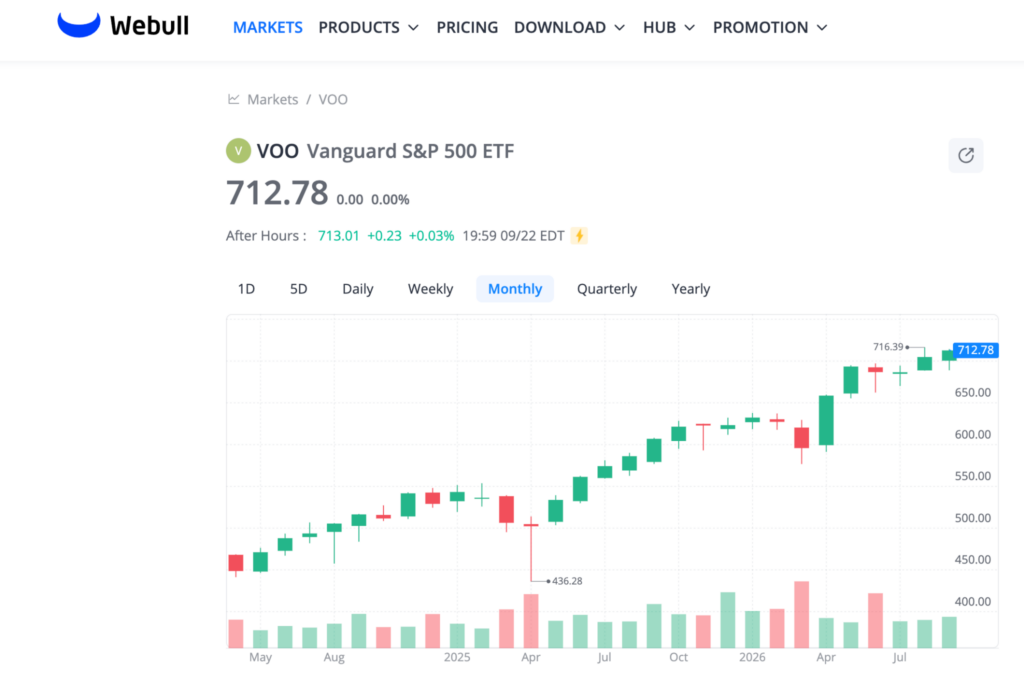
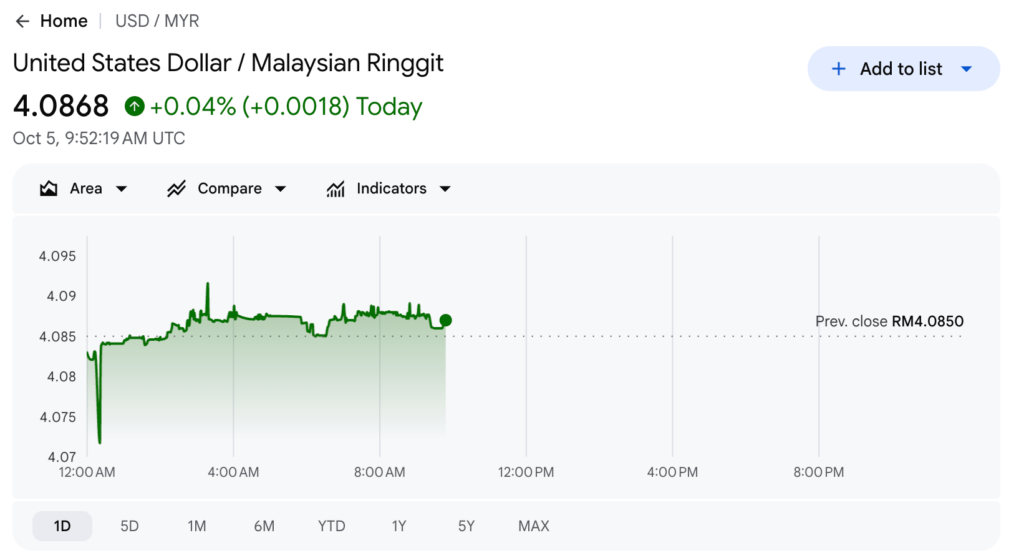
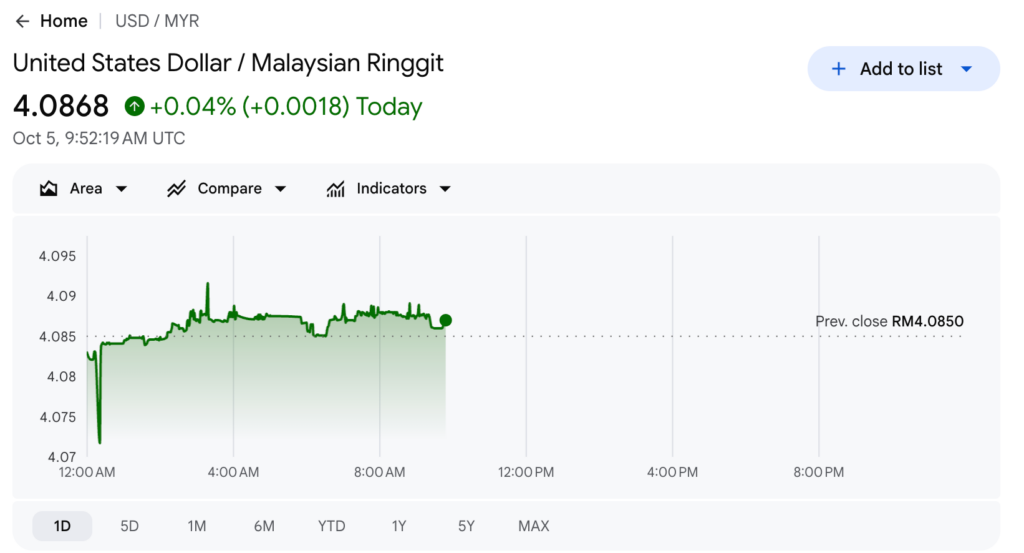
Take VOO, one of the most popular S&P 500 ETFs. One share trades above USD 700. At around RM4.09 to the dollar, that’s roughly RM2,900 for a single unit, close to a full month’s salary for many fresh graduates. On a RM300 monthly budget, that’s almost 10 months of saving just to buy one share.
The good news: you don’t have to. Fractional shares let you buy part of a share instead of a whole one. RM300 buys a RM300 slice, and that slice moves exactly the same way the full share does. The question shifts from “can I afford it?” to “how much am I putting in this month?”
This is where dollar-cost averaging (DCA) helps. You invest a fixed amount at regular intervals, regardless of price. There’s no single lump-sum moment you have to get right.
And if the price falls the week after you buy? All that tells you is that the price is lower than when you bought it. That’s it. One bad week says almost nothing about a decision made for the long term.
This is why starting small matters more than starting perfectly. There’s a real gap between understanding volatility in theory and opening your app on a red day with your own money inside. It’s far better to meet that feeling at RM300 than at RM50,000. Watching a full year’s savings drop is something that’s hard to describe until you’ve lived through it.
There’s also a quieter risk. Month one, motivation is high and you invest. Month two, you’re busy, or the market looks uncertain, so you’ll “do it next week.” Before long, the plan has quietly stopped being a plan.
Fixed RSP: Make The Decision Once
If you’ve already decided what the money is for, what you want to own, and how much you can contribute, a Regular Savings Plan (RSP) simply carries out that decision for you, automatically.
Instead of deciding 12 times a year, you decide once. The amount can still be changed whenever your finances or goals change. Nothing is locked in, and there’s no maturity date to wait for.
Why does this matter more than it sounds? Because the obstacle is psychological. When prices rise, it feels like you’ve missed the boat. When prices fall, it feels safer to wait and avoid “catching a falling knife.” Both feelings are understandable, and both lead to the same result: doing nothing. A scheduled contribution gives you something to follow through both.
Here’s how it looks with numbers. Say you invest USD 50 a month (roughly RM204 at USD 1 = RM4.09):
| Month | Unit Price | Contribution | Unit purchased |
| 1 | USD 713 | USD 50 | 0.07013 |
| 2 | USD 680 | USD 50 | 0.07353 |
| 3 | USD 740 | USD 50 | 0.06757 |
Month 2 looks like a bad month, because what you bought in Month 1 is now down. But it’s also the month the same USD 50 bought the most units. In Month 3, the price is higher, so the same amount buys less.
Doing this manually is easier said than done. The moment you should be buying is usually the moment you least want to. A recurring plan just does it while you’re not looking.
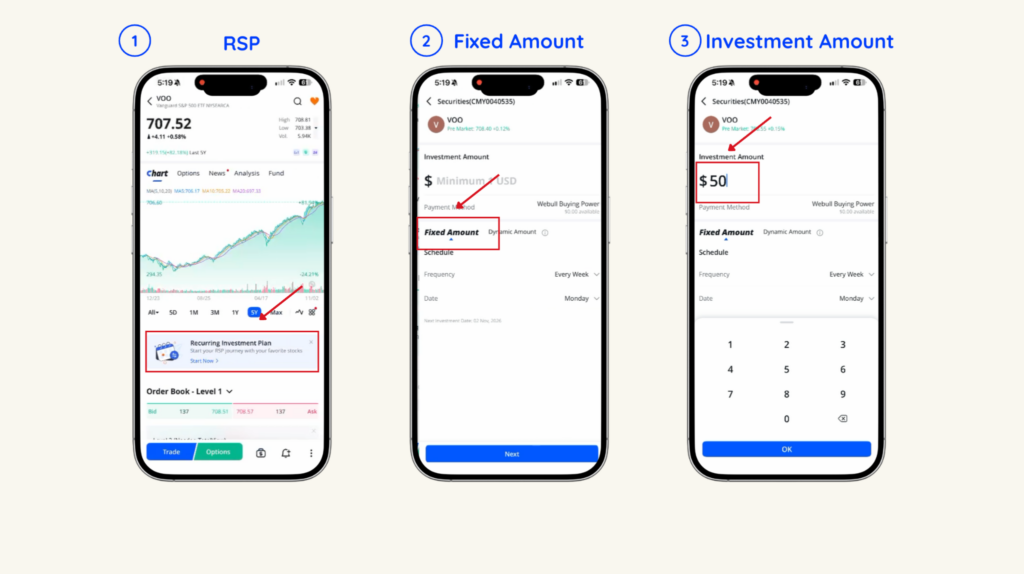
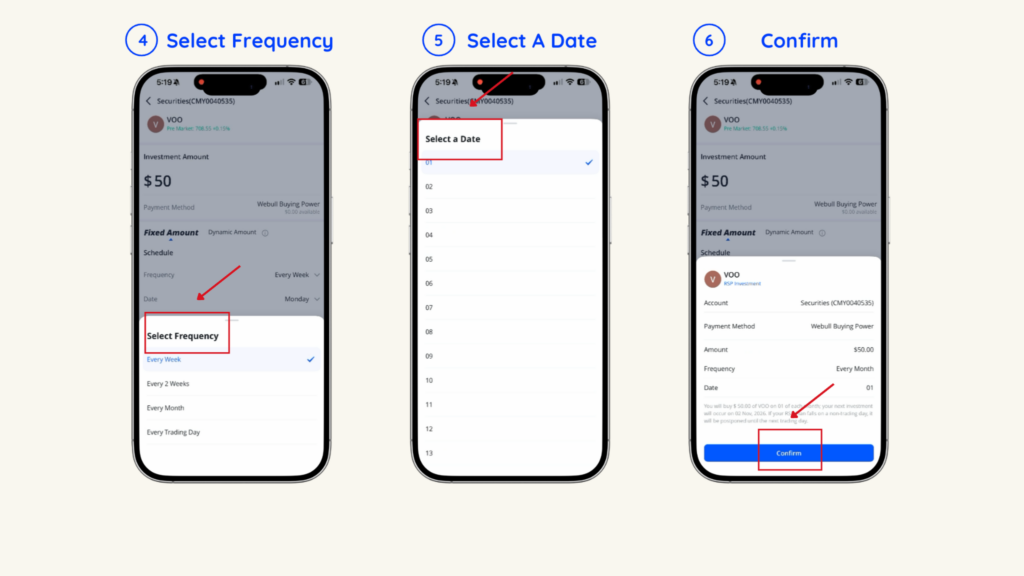
How to set up a Fixed RSP on Webull
Webull’s Fixed Recurring Stock-Investment Plan starts from USD 1 and supports fractional shares:
Dynamic RSP: Buy More When It’s Cheaper
Once you’re comfortable with a fixed plan, there’s a second version worth knowing.
With a fixed plan, the amount stays the same and the number of units changes. With a dynamic plan, the amount itself changes: more when prices are lower, less when they’re higher. Webull’s Dynamic RSP applies this idea, known as value averaging, by comparing a benchmark’s previous close against a moving average you select. Below the average, it increases your contribution. Above it, it reduces it.
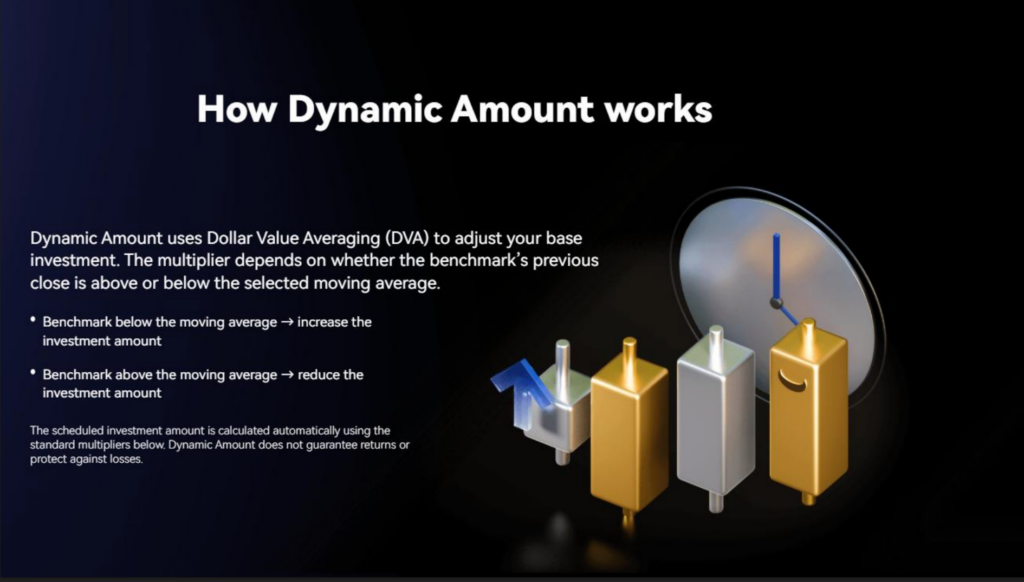
To set it up, follow the same RSP steps as above, but select Dynamic amount. Here’s an example configuration:
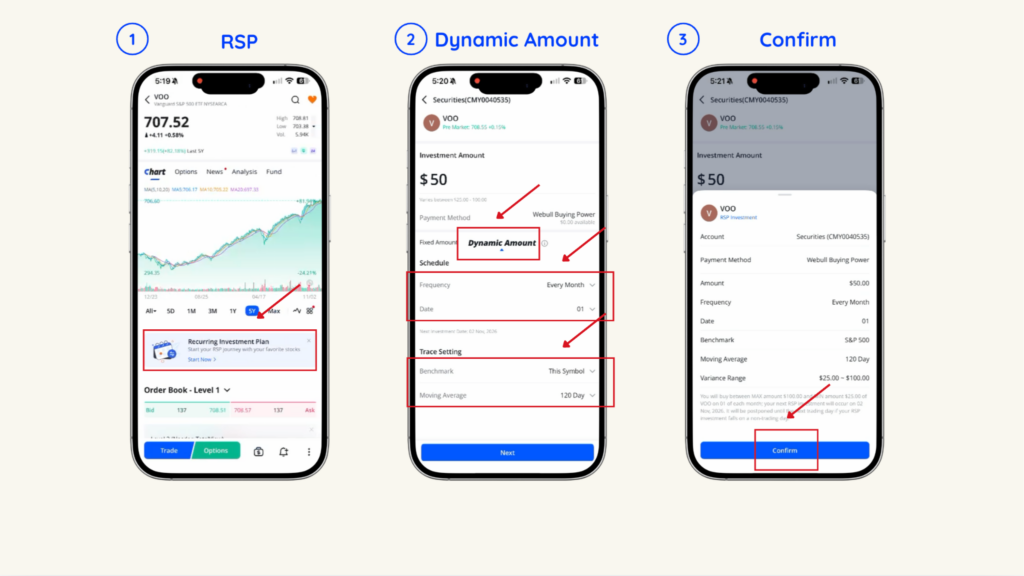
| Setting | Example |
| Investment | VOO |
| Base amount | USD 50 |
| Frequency | Monthly |
| Date | 1st of the month |
| Benchmark | This Symbol (VOO) |
| Moving average | 120-day |
Two settings deserve a closer look.
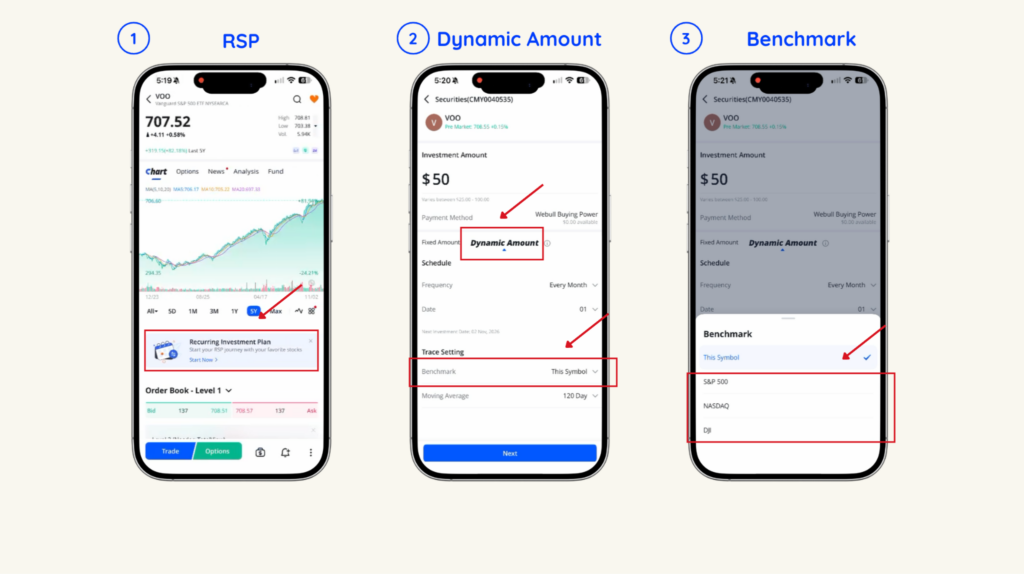
Benchmark: what decides “cheap” or “expensive”
The benchmark is what the system checks to decide whether to top up. By default, it’s set to “This Symbol”, meaning VOO is measured against its own average. You can switch it to a broader benchmark such as the S&P 500, Nasdaq, or DJI. This doesn’t change what you’re buying or when. It only changes what triggers the top-up.
This matters most for single stocks. Say your plan buys NVIDIA with the benchmark on “This Symbol”. The plan tops up whenever NVIDIA falls below its own average. But a stock can fall for reasons unrelated to the market being cheap: weak quarterly results, a major customer leaving, or a regulatory problem. In that case, your plan puts in more money precisely because that one company is in trouble.
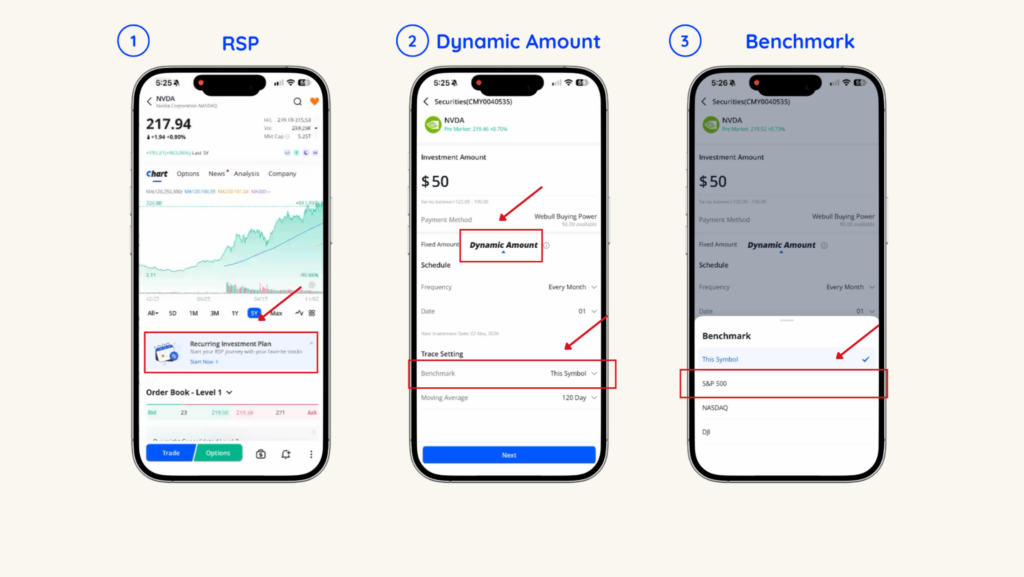
Switch the benchmark to the S&P 500, and the top-up only happens when the broader US market is down. A bad week for one company on its own changes nothing.
The question to ask yourself: when do you want the extra money to go in? If it’s “when this company’s price drops,” keep “This Symbol”. If it’s “when the whole market is having a bad month,” choose a broader benchmark.
Moving average: how quickly the plan reacts
The moving average is the average of past prices over the period you select. In the VOO example, the system compares VOO’s previous closing price with its own 120-day moving average. Webull also offers longer options such as 250-day and 300-day.
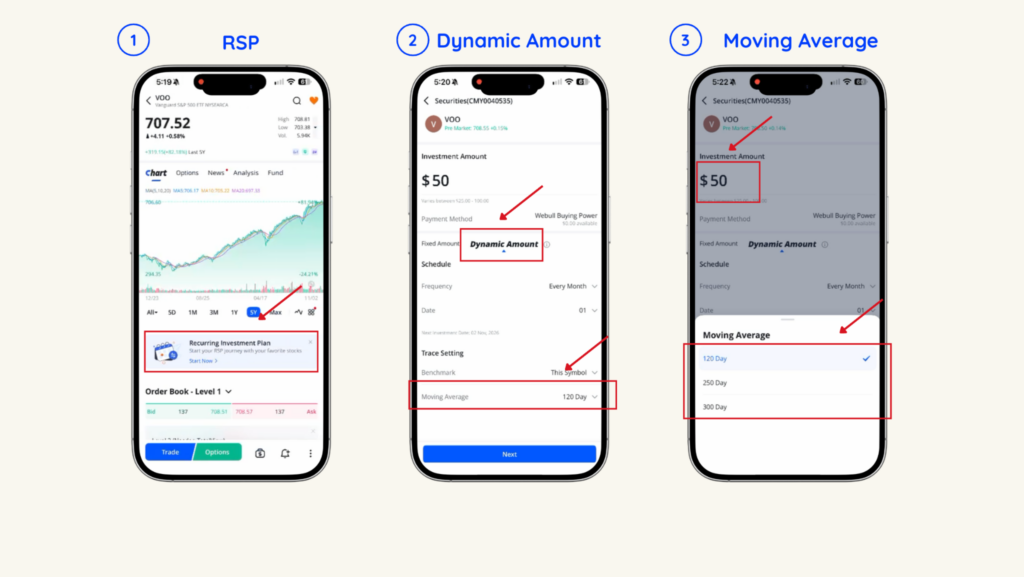
A shorter average reacts faster, so your contribution changes more often. A longer one moves slowly, so the plan only responds to bigger moves. There’s no correct answer here; it depends on how often you want the amount to change.
How the amount is calculated
Scheduled investment amount = Base amount × Multiplier
The multiplier ranges from 50% to 200%, based on the benchmark’s previous US trading-day close relative to its moving average.
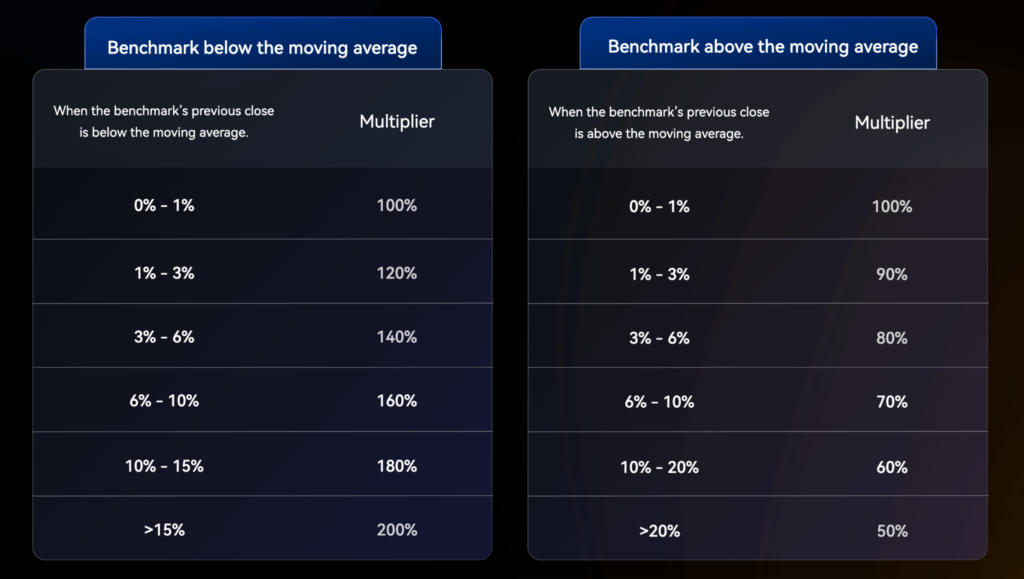
Assuming VOO’s 120-day moving average is USD 680:
| Scenario | VOO previous closing price | 120-day moving average | Fixed RSP | Dynamic multiplier | Dynamic RSP |
| Above | USD 713 | USD 680 | USD 50 | 80% | USD 40 |
| At the average | USD 680 | USD 680 | USD 50 | 100% | USD 50 |
| Below | USD 650 | USD 680 | USD 50 | 140% | USD 70 |
Multipliers shown are illustrative; Webull ’s system determines the actual figure.
The useful part is that every adjustment follows rules set in advance. You’re not waking up to a red market and deciding on the spot how much extra to put in.
Multiplier range
This is the detail most people miss: your base amount is not your maximum contribution. Look at the small line under the amount field in the app. On a USD 2 base, it shows a range of USD 1 to USD 4, the 50% floor and the 200% ceiling.
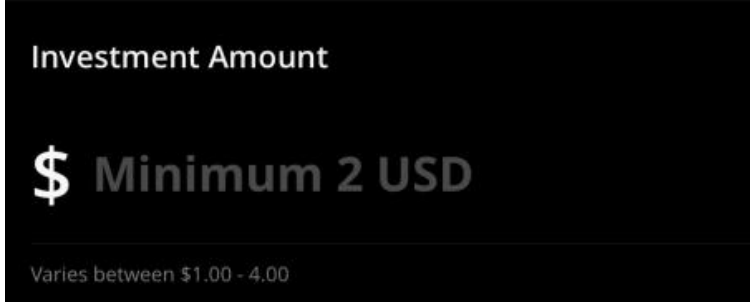
| Floor (50%) | Base (100%) | Ceiling (200%) |
| USD 25 | USD 50 | USD 100 |
On a USD 50 base, a single contribution could reach USD 100. Make sure your budget can handle that. Don’t set a USD 50 base if USD 50 is the most you can afford.
In short, a Fixed RSP is easier to plan around with a fixed monthly budget. A Dynamic RSP gives you variable contributions, but you need to understand and fund that variation.
In the interest of transparency: Dynamic RSP relies on Webull’s own back-end system to make these adjustments, and it’s still a relatively new product. There are no official publications or test reports available to independently review or cross-check its performance yet. If you try it out, share your experience with us.
Final Thoughts
If your next step is still building an emergency fund or sorting out existing commitments, that’s progress too. Everyone starts there.
And yes, returns look small when capital is small. A 10% return on RM1,000 is only RM100, which can feel like it isn’t worth the effort. But what you’re really buying at this stage is time, and a structure that will already be in place when the numbers stop being small.
There’s one more thing you gain from starting small: you learn about yourself. You’ll discover whether you’re naturally comfortable with risk, or far more cautious than you assumed. Either way, the approach is the same. Start small, and invest consistently.
If you’d like to try RSP yourself, you can sign up for a Webull account here using my code ziet888. Webull is currently giving out RM 300 worth of Nvidia shares to new users when you deposit RM5,000 and maintain it for 60 days. New users also get zero-commission US stock trading for one year from account activation.
Anyways, if you prefer a video version of this article, I have made a video covering the exact same thing – do check it out here! Thanks for reading!
Disclaimer: This content is sponsored by Webull. This advertisement has not been reviewed by the Securities Commission Malaysia. T&C applies.
Share the Wealth
Found this information useful? Share this post with your friends and family to help them stay informed about what’s happening around them. And if you’re not already subscribed, join our community to receive more insightful content directly to your hands.


