

Estimated reading time: 18 minutes
Most Malaysian investors probably have more money invested in Malaysia than they realise.
You might look at your stock portfolio and think: RM20,000 in Maybank, RM10,000 in Sunway, a little 99 Speedmart, some Tenaga… maybe 60% Malaysia overall.
But your Bursa portfolio is only part of the picture.
Your salary depends largely on the Malaysian economy. Your savings and fixed deposits are probably denominated in Ringgit. If you own a home, that is another major Malaysian asset.
Now, add your Malaysian stocks on top.
Suddenly, a very large part of your financial life depends on the same country, economy and currency.
That concentration may feel perfectly comfortable when Malaysia is doing well. But what if things aren’t going well in Malaysia?
So does your next Ringgit really need to make the same Malaysian bet again?
In this guide, I’ll explain why home bias matters, what Malaysian investors can access overseas, why I personally pay particular attention to the US market, and how beginners can approach global investing with Moomoo without immediately trying to become expert stock pickers.
TABLE OF CONTENTS
- Why Home Bias Can Be a Problem
- Where Can Malaysians Invest Outside Bursa
- Why the US Is Worth Considering
- Your EPF Already Invests Overseas
- Understanding Big Money Movements with Moomoo AI
- New to US Stocks? Start With ETFs
- How to Research US Stocks From Malaysia
- Consider Recurring Investments
- Final Thoughts
Why Home Bias Can Be a Problem
We tend to invest in what we know. For Malaysians, that usually means Malaysian stocks, Malaysian property, Ringgit savings, and local fixed deposits. Economists call this home bias, the tendency to keep more of our wealth in our home country simply because it feels familiar.
And honestly, that instinct makes sense.
Buying a company listed thousands of kilometres away, trading in another currency and operating while we are asleep naturally feels riskier.
But familiarity and diversification aren’t the same thing.
Let’s take the FTSE Bursa Malaysia KLCI as an example. It tracks 30 of the largest and most actively traded companies on Bursa Malaysia, and for most people, it is the closest shorthand for how “the Malaysian market” is doing.
Over the past 10 years, though, the KLCI’s annualised price return was only around 0.4%.
That does not mean investors made just 0.4% a year in total. Malaysian blue-chip stocks tend to pay dividends, and those dividends make up an important part of the return.
But if we look purely at the index level itself, there really was not much capital growth over the decade.
And once you look inside the KLCI, you can see why the market behaves the way it does. More than 40% of the index is made up of financial stocks, mainly the big banks. Add heavyweight names like Tenaga, and a large part of the KLCI’s performance still depends on a relatively small group of sectors.
So even though the index contains 30 companies, the exposure is not as evenly spread out as the number might suggest.
That helps explain why the KLCI is set to expand from 30 to 50 constituents from December 2026, its first major change to the number of constituents since 2009. A broader index should give investors exposure to a wider mix of companies and sectors.
But for Malaysian investors, the bigger question is still the same.
If your salary, savings, property and existing investments are already tied to Malaysia, how much extra diversification are you really getting by putting your next Ringgit into another Malaysian asset?
Where can Malaysians invest outside Bursa?
If you want to reduce your exposure to a single country, then at least part of your portfolio has to go beyond Malaysia.
The good news is that this is much easier today. Through apps like Moomoo, Malaysian investors can access multiple markets from one platform, including the US, Malaysia, Hong Kong, China and Singapore.
That opens up a much wider pool of companies, sectors and currencies to invest in, instead of limiting your choices to Bursa alone.
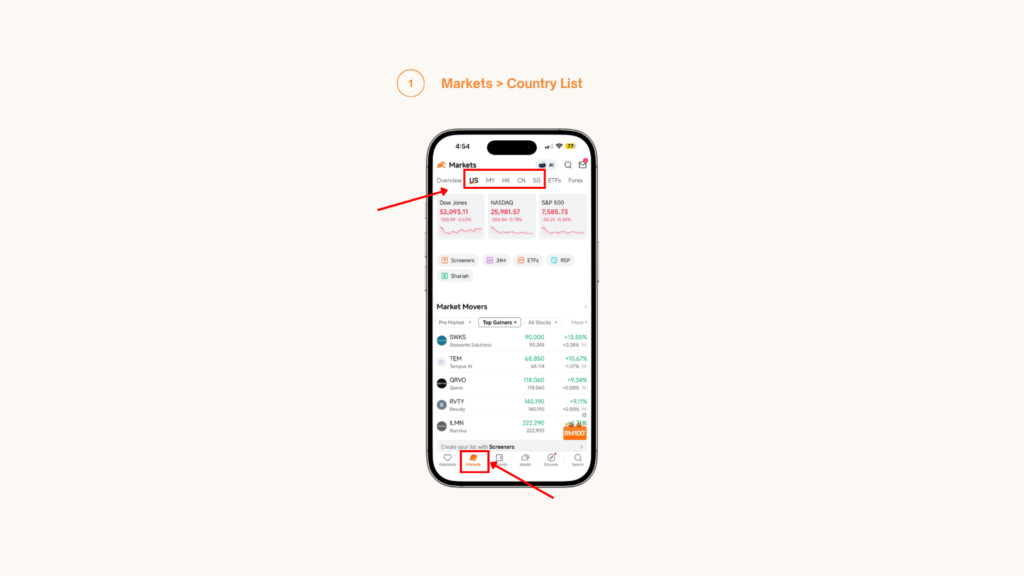
You definitely don’t need to research every market at once.
To keep things simple, I’d start with the one that has the biggest influence on global markets: the United States.
It’s where you’ll find companies like Apple, Microsoft, Amazon and Alphabet, those businesses whose products and services many of us already use every day.
More importantly, the US market has a long track record of producing some of the world’s biggest growth companies.
So if you’re deciding where to look beyond Bursa, this is a good place to start. Here’s why.
Why the US Is Worth Considering?
1. You can invest in industries Bursa doesn’t offer at the same scale
Let’s take a look at Malaysia’s Heat Map, basically a birds eye view of the entire Bursa Malaysia.
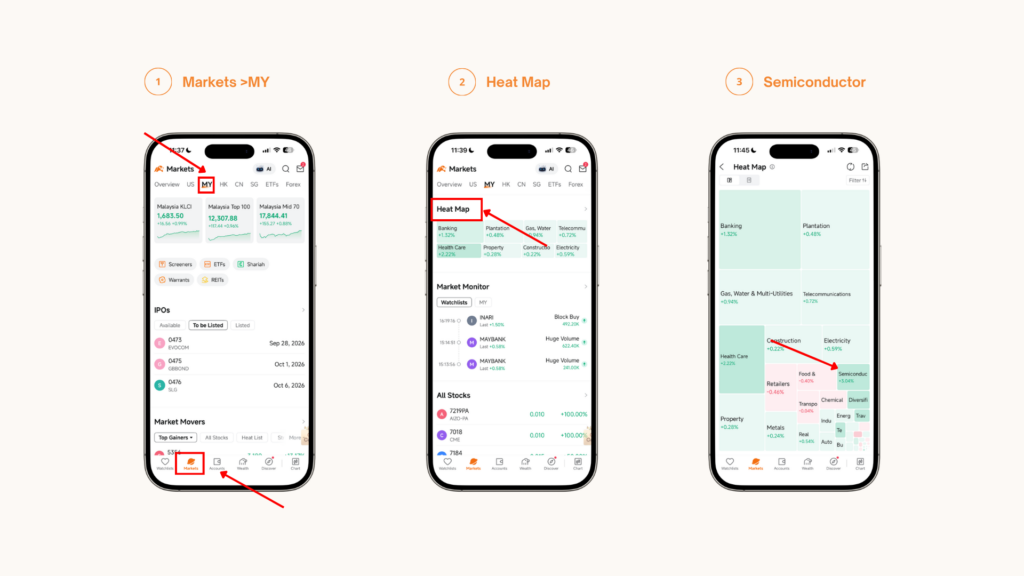
You’ll quickly notice that Malaysia has some genuinely strong listed businesses, especially in sectors like banking, plantations, utilities and property.
But there are also major industries where Bursa simply doesn’t have the same depth or variety.
Malaysia plays an important role in the global chip supply chain, especially in assembly, testing and packaging (ATP). In fact, Malaysia handles roughly 13% of global chip testing and packaging.
The issue is that ATP generally sits further down the value chain, where margins are lower than in areas like chip design and advanced semiconductor manufacturing.
So if you want exposure to the higher-value parts of the semiconductor ecosystem, you’ll probably need to look beyond Malaysia.
For example, NVIDIA (from the US) designs the chip; ASML (from the Netherlands) makes some of the crazy expensive machines needed to produce the most advanced chips; and then, TSMC (from Taiwan) manufactures it.
The same idea applies to other industries too, including hyperscale cloud computing, advanced AI platforms, biotechnology and global healthcare.
These are areas where Bursa simply doesn’t offer the same range of listed companies. Investing internationally gives you access to a much wider set of businesses, technologies and growth themes that would otherwise be difficult to own from Malaysia alone.
2. Overseas investing also diversifies your currency exposure
When you buy a US stock, you’re really exposed to two things at once.
First, the company itself, whether the business performs well.
Second, the US dollar, whether it becomes stronger or weaker against the Ringgit over time.
For Malaysian investors, that second part matters because the US dollar plays a major role in the global financial system, which makes it an important source of currency diversification for a portfolio that is otherwise heavily tied to MYR.
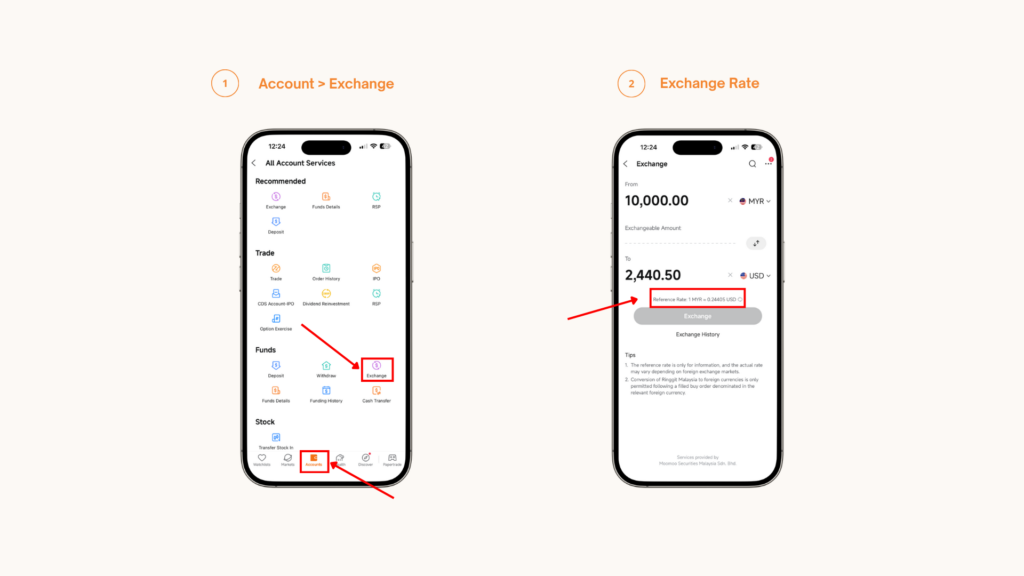
Even today, the US dollar remains the world’s dominant reserve currency. Around 57% of global foreign-exchange reserves are held in US dollars, while the euro accounts for roughly 20%.
That gap shows just how central the US dollar still is to the global financial system.
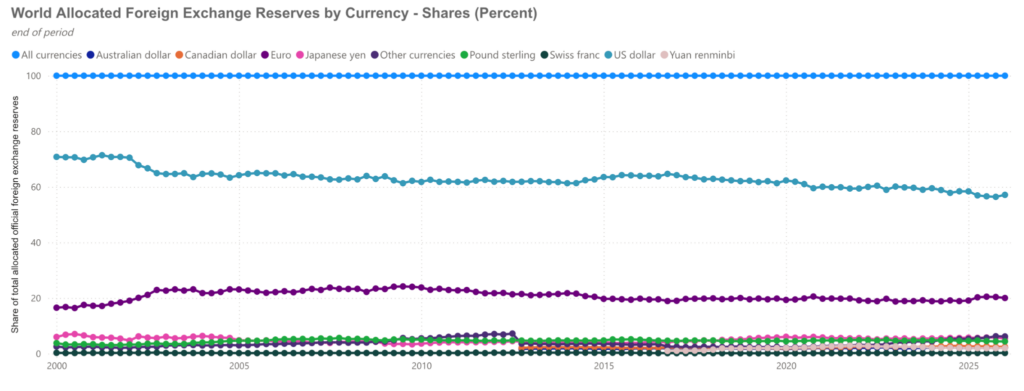
Even the dollar’s share has been coming down over time, but it is still comfortably sitting at number one, and potentially for the foreseeable future as well.
And historically, during periods of major global stress, think financial crises or the pandemic, investors have often moved money into US dollar assets as a safe haven.
For Malaysian investors, the practical takeaway is simple: Malaysian and US assets can still fall at the same time. But holding US assets gives you exposure to another major currency instead of having your entire financial life tied to the Ringgit.
3. The US market has historically delivered strong long-term growth
The US market has a strong long-term track record. Over roughly seven decades, the S&P 500 has returned around 10.5% annually.
And the past decade was far from smooth. Investors went through COVID-19, rapid interest rate hikes, the 2022 market sell-off, geopolitical conflicts and major trade shocks.
Despite all of that, the US market still delivered strong long-term growth over the period.
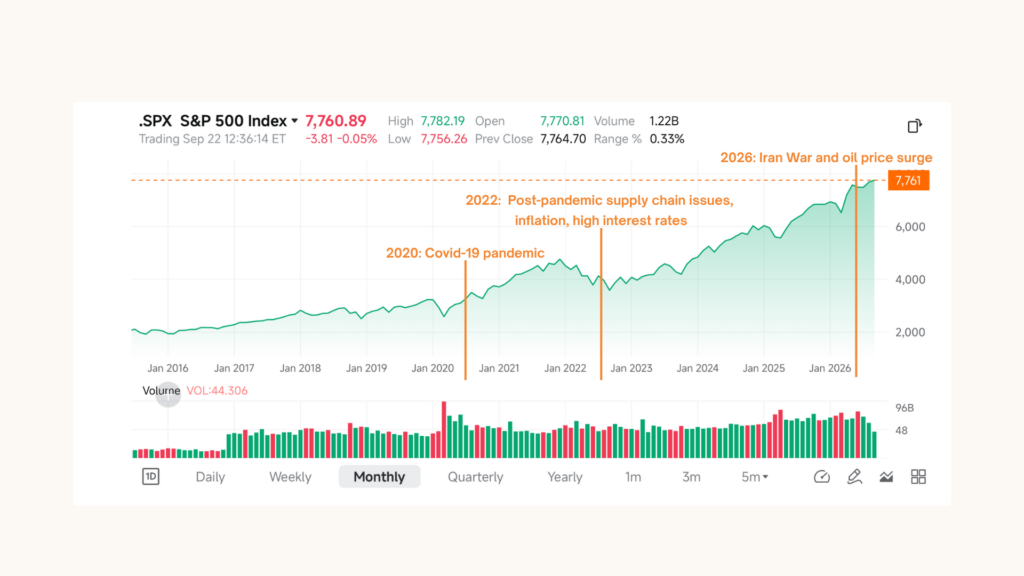
By August 2026, the S&P 500 had climbed back to record-high territory. Over the previous 10 years, its annualised price return was roughly 13.5%.
One reason is what actually sits inside the US market. It has much heavier exposure to sectors such as technology, semiconductors, artificial intelligence and global healthcare. Those industries that have been major growth drivers over the past decade.
To put that into perspective, US$10,000 invested in the S&P 500 around July 2016 would have grown to roughly US$35,000 by July 2026, before dividends.
The KLCI has a different market structure. It has more exposure to mature sectors such as banking, utilities and plantations, where companies often return a larger share of profits to investors through dividends.
So over the same period, Malaysian investors received more of their returns as income, while US investors benefited more from capital growth.
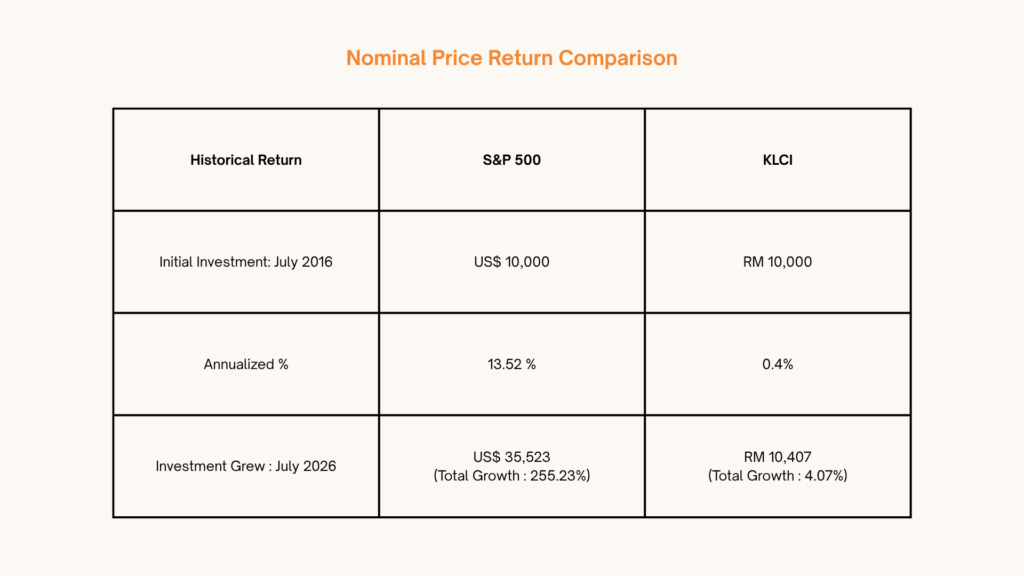
As we mentioned earlier, the KLCI’s price return was much flatter, and a bigger part of investors’ returns came from dividends.
The KLCI’s average dividend yield was around 4.5%, compared with roughly 1.4% for the S&P 500.
A simple way to think about it is this: Malaysian investors received more of their returns as cash along the way, while US investors benefited more from rising share prices.
For Malaysians investing in US stocks, there is one extra thing to keep in mind. US dividends are generally subject to a 30% withholding tax. So if the dividend yield is 1.4%, the amount that actually reaches you is closer to 1%.
Even with that tax, the S&P 500 still delivered a much stronger overall return over the period.
Your EPF Already Invests Overseas
Interestingly, you may already have overseas exposure even if you have never bought a foreign stock yourself.
Every month, part of your salary goes into EPF, and EPF invests that money across both Malaysian and international markets.
By the end of 2025, around 38.3% of EPF’s RM1.4 trillion portfolio was invested outside Malaysia. Those overseas investments contributed more than 50% of EPF’s total investment income for the year.
So in a way, part of your retirement savings is already doing exactly what we have been talking about: spreading exposure beyond Malaysia.
And that is really the point of diversifying across countries. If too much of your wealth is tied to one market, you are taking on more country-specific risk without necessarily getting a better return for it.
If you are curious where that institutional money is actually going, one Moomoo feature I find useful is the Institutional Tracker.
Step to Use Moomoo’s Institutional Tracker:
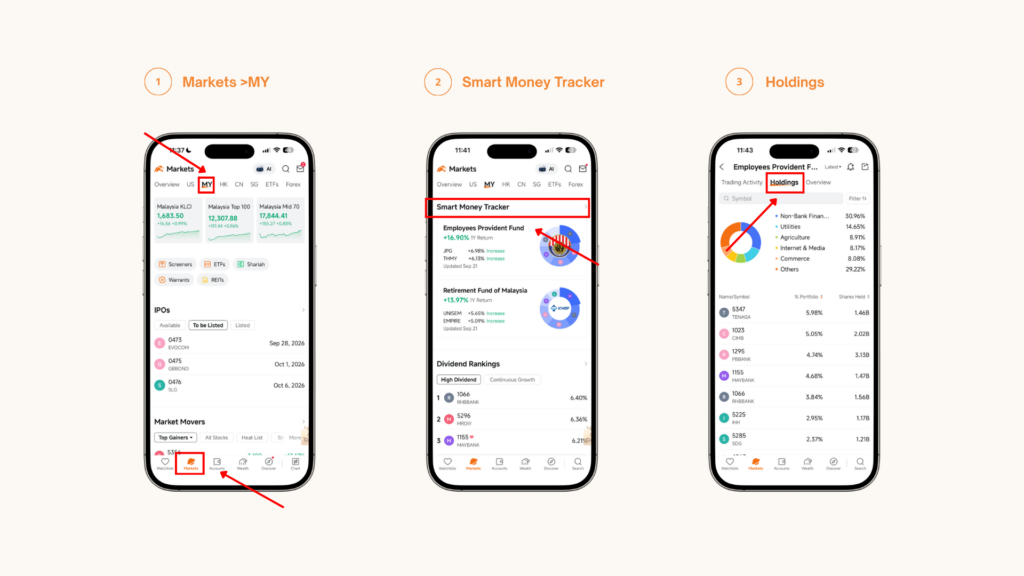
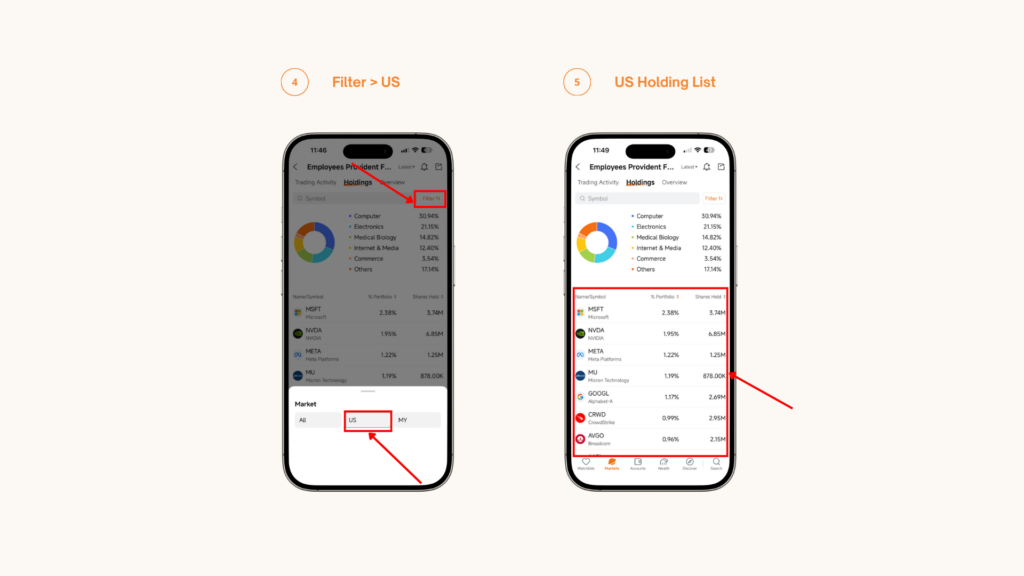
You can search for an institution like EPF and look at its reported US holdings, including the sectors it is exposed to, the companies it owns, and where it has been adding or reducing positions.
I would not use this to blindly copy EPF. Their portfolio size, investment horizon and mandate are very different from ours. But it can be a useful starting point for research and help you spot sectors or companies that may be worth digging into further.
And EPF is just one example. You can also look at global institutions like Vanguard or Warren Buffett’s Berkshire Hathaway. So if you are completely new to US stocks, watching where large institutions are allocating capital can at least give you clues on which sectors and companies are worth researching next.
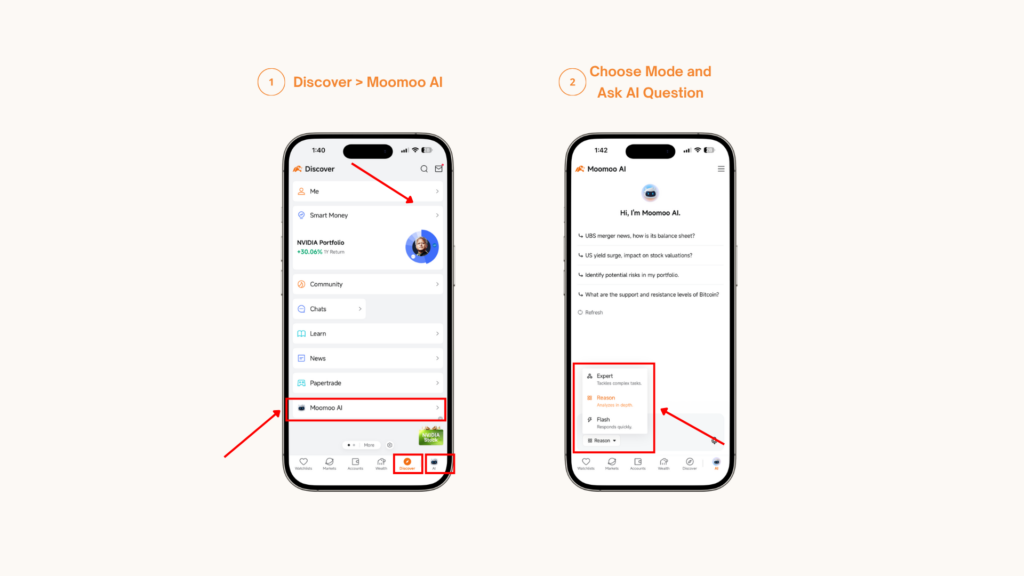
Understanding Big Money Movements with Moomoo AI
Instead of going straight to Google and asking, “What US stock should I buy?”, I find it more useful to ask why large institutions are moving money in the first place.
This is where Moomoo AI can help organise the research.
For example, I might ask:
- Why is BlackRock investing heavily in the energy and power infrastructure industry?
- What kind of overseas exposure are they getting that is harder to access in Malaysia?
- Which companies are benefiting from that trend?
Moomoo AI can then help summarise the information available on the platform and connect the dots between sectors, companies and institutional holdings.
For me, that makes it a useful starting point for research to decide what is worth looking into further.
Step to Use Moomoo’s AI:
New to US Stocks? Start With ETFs
Once you start looking at US stocks, the number of choices can get overwhelming very quickly.
There are thousands of listed companies, and researching them one by one takes time.
For beginners who simply want broad market exposure, an exchange-traded fund (ETF) can make things much easier.
An S&P 500 ETF, for example, gives you exposure to around 500 large US companies in a single investment. A total market ETF can spread your money across thousands of US companies.
That way, your portfolio is less dependent on whether one individual company does well or badly.
Three things I look at when comparing ETFs
1. Expense ratio
This is the annual fee charged by the fund. A fee of 0.03% may appear tiny, but costs accumulate over long investing periods.
2. Holdings and sector exposure
Always check what an ETF actually owns.
QQQ, for example, follows 100 of the largest non-financial companies listed on Nasdaq and has significant technology exposure.
VTI tracks a much broader section of the US stock market, although technology can still represent a large portion of the fund.
An ETF can contain hundreds of companies while remaining heavily exposed to one sector.
3. Fund size and liquidity
Larger, actively traded ETFs tend to have plenty of buyers and sellers.
VOO, for example, has around a trillion US dollars in assets.
SPUS, a Shariah-compliant ETF that invests in US companies passing its Shariah screening methodology, has assets closer to US$3 billion.
Trading activity also affects the bid-ask spread, which is the difference between the price buyers are willing to pay and the price sellers are asking for.
Moomoo‘s ETF comparison tool is useful at this stage.
Step to Use Moomoo’s comparison tool:
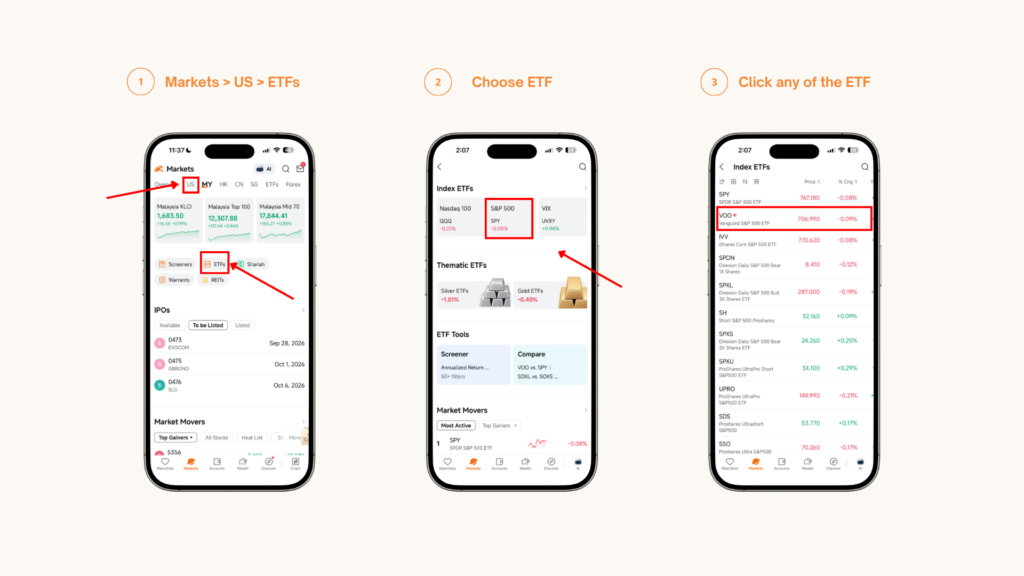
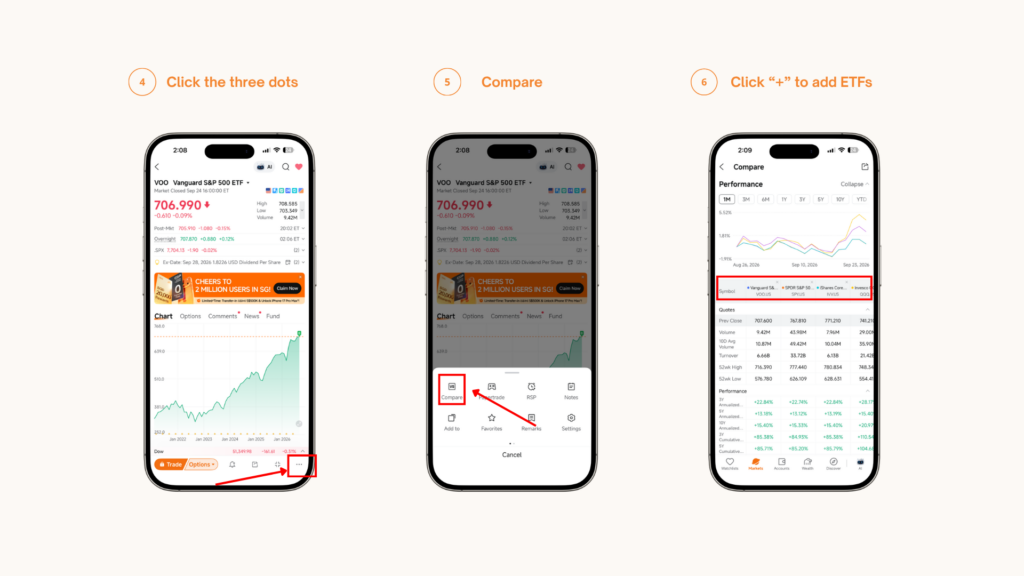
For someone choosing between a broad-market ETF, a technology-focused ETF, or a Shariah-compliant ETF, having the key details side by side makes the comparison much easier.
You can quickly see how they differ in fees, holdings, sector exposure and fund size, instead of opening multiple websites and trying to piece everything together yourself.
How to Research US Stocks From Malaysia
Once you start investing in the US, you’ll quickly discover another problem.
There is an enormous amount of information. You have company earnings, analyst reports, Federal Reserve decisions, tariffs, economic data, industry news, Reddit, X, YouTube and financial media all competing for your attention.
The US market also trades while most Malaysians are asleep. You can wake up in the morning and discover that a stock has moved 10% overnight.
Let’s say you’re researching NVIDIA and it suddenly falls 13%.
The first questions I’d ask are:
- Was there company-specific news?
- Did something happen to the semiconductor sector?
- Was there another export restriction?
- Did a competitor announce something important?
- Or did the entire market sell off?
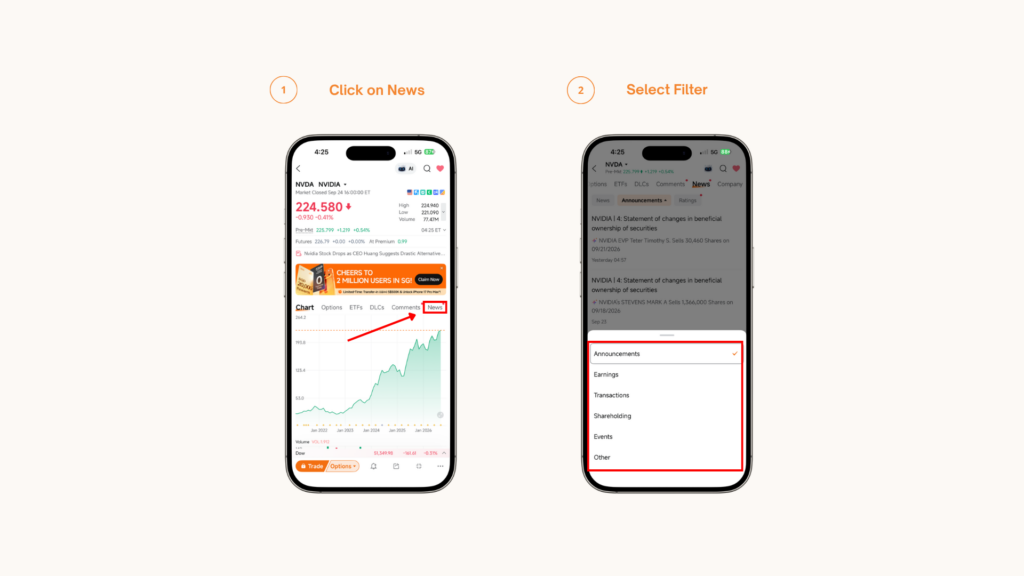
This is another area where Moomoo fits naturally into my workflow.
Its 24/7 global news feed gives me one place to check recent developments around the company and broader market.
Step to Use Moomoo’s news feed tool:
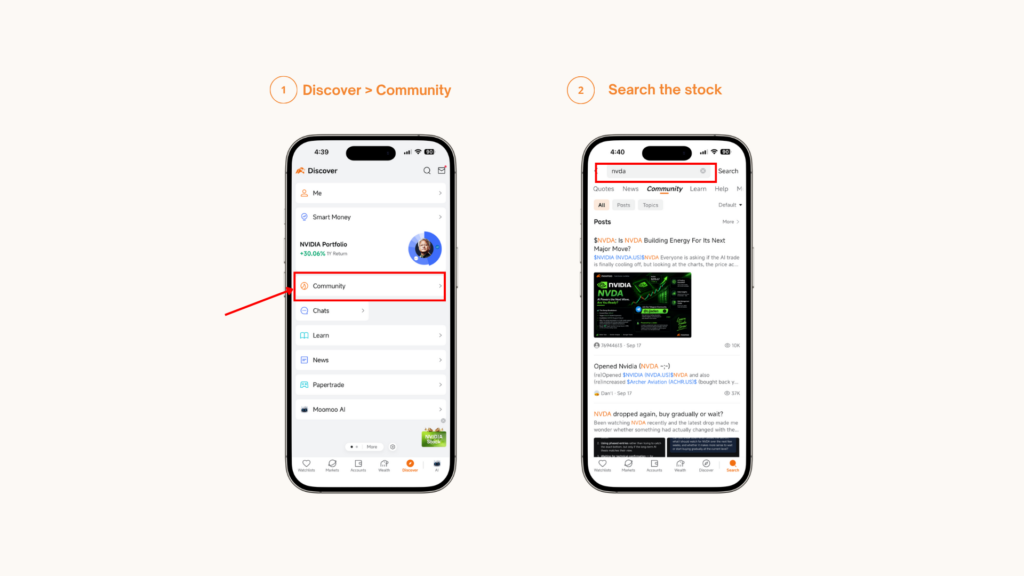
Then I’ll look at investor discussions to see what other issues people are focusing on.
Moomoo‘s community has more than 30 million users globally, so popular stocks usually have ongoing discussions around them.
I see those discussions as another source of research ideas.
Someone might highlight margins, valuation, competition or an upcoming regulatory change that I hadn’t considered yet.
I can then verify the issue myself using company filings and other primary sources.
Step to Use Moomoo’s community tool:
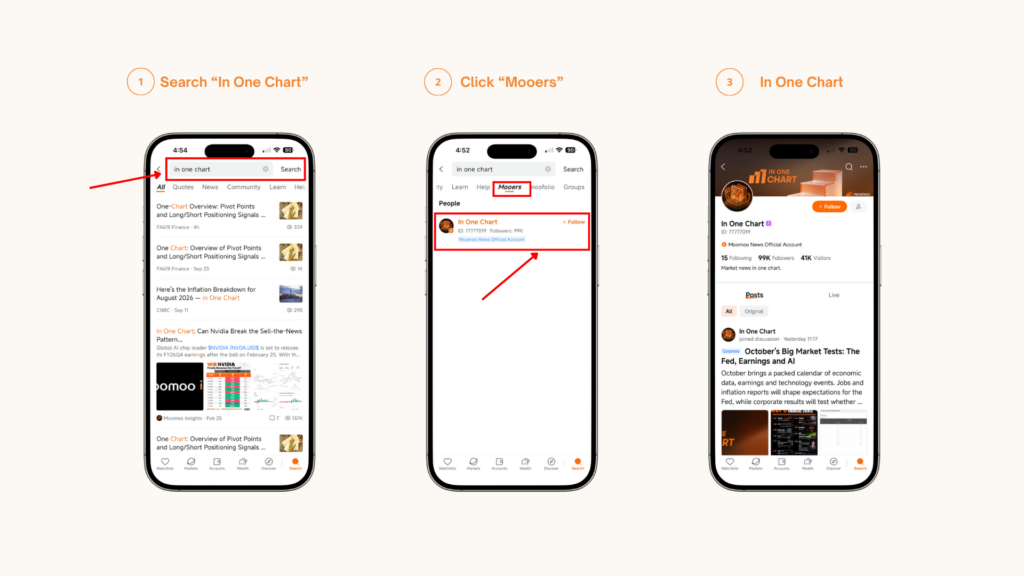
Moomoo also has its “In One Chart” content, which takes a market theme and explains it through a chart together with related companies.
Again, I use this for idea generation.
It can give you a starting point when you’re trying to figure out what to research next.
Step to Use Moomoo’s In One Chart tool:
Consider recurring investments if timing keeps stopping you
Eventually, every investor runs into the same question:
“When should I buy?”
You can spend weeks researching a stock or ETF and still hesitate because you are worried the price might drop the next day.
For long-term investors, one way to deal with that is dollar-cost averaging.
The idea is simple: invest a fixed amount at regular intervals instead of trying to find the perfect entry price every time.
Moomoo offers this through its Recurring Investment Plan, or RSP.
You choose the investment, the amount, and how often you want to invest, then the plan follows that schedule automatically.
So if you have already decided that you want long-term exposure to a broad US ETF, you could simply set up a monthly recurring investment and keep going.
Step to Use Moomoo’s RSP tool:
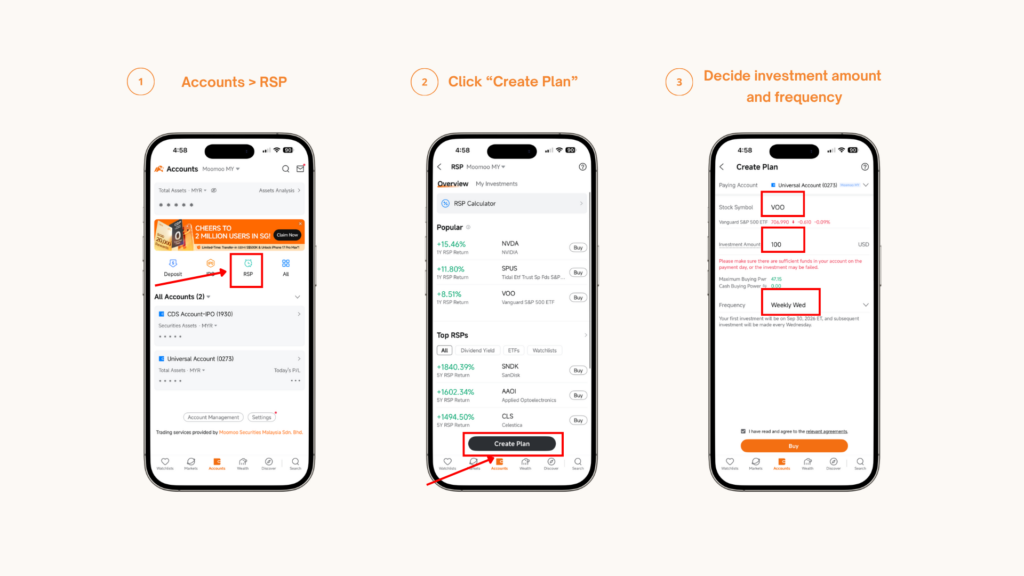
The real benefit here is behavioural. You make the decision once, then follow the plan instead of asking yourself every month whether now is the “right” time to buy.
Final Thoughts
A Malaysian investor’s portfolio extends far beyond the stocks visible inside a brokerage account.
Your income, savings, property, EPF and local investments all form part of your overall financial exposure.
Once you look at your wealth from that perspective, investing overseas starts to make more sense as a diversification tool.
And platforms such as Moomoo make the process easier by bringing several parts of that journey into one place. The platform is also licensed by the Securities Commission Malaysia, which is an important consideration when choosing a broker locally.
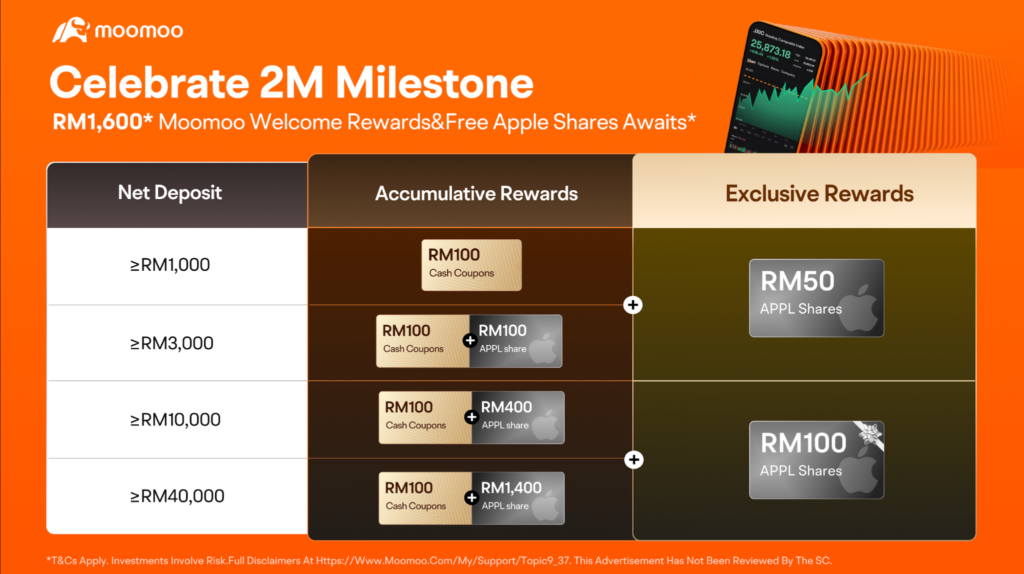
If you’re interested in opening a Moomoo account, you can use my code ZIET11 for the additional promotional rewards available under the campaign.
At the time of publication, new users can receive rewards worth up to RM1,600, including Apple share rewards and cash coupons. Promotions and eligibility requirements can change, so check the latest campaign terms through my link before signing up.
Before deciding where to invest, look at the exposure you already have. Then ask yourself a simple question: Where does your next Ringgit add something new to your portfolio?
Anyways, if you prefer a video version of this article, I have made a video covering the exact same thing – do check it out here! Thanks for reading!
*T&Cs apply. All views expressed in this blog are the independent opinions of Ziet, which are not shared by Moomoo Securities Malaysia Sdn. Bhd. (“Moomoo MY”). No content shall be considered financial advice or recommendation. Moomoo MY links are included in this post, through which referrals are made and I may receive certain commissions. Please contact Moomoo MY for more information.
Share the Wealth
Found this information useful? Share this post with your friends and family to help them stay informed about what’s happening around them. And if you’re not already subscribed, join our community to receive more insightful content directly to your hands.


