

Estimated reading time: 21 minutes
You open your portfolio and see one of your stocks up 40%. You’re pleased with the gain, and you might already be thinking about what that money could pay for.
Then comes the question: “Should I sell now?” Suddenly, you’re weighing the possibility of further gains against the risk of watching your profit disappear.
A losing investment can leave you equally stuck. Perhaps you bought a stock at RM2 and have been waiting for it to recover ever since. Each time you check the price, you find another reason to give it a little longer.
Your purchase price, expectations and emotions gradually become part of the decision.
Having a clear selling process helps you work through these situations. Reviewing the company’s performance, valuation and place in your portfolio gives you a more grounded way to decide what to do. Your own financial needs matter too, especially when an upcoming expense depends on money you currently have invested.
In this guide, I’ll walk through five questions to help you decide whether to hold, trim or sell a stock. I’ll also show how Moomoo’s research tools, valuation information, charts and order features can help you work through the decision and put your plan into action.
TABLE OF CONTENTS
Understanding What Is Driving Your Decision
Selling can bring up several emotions at once, especially when you have spent time researching a company and watching its share price. Before reviewing the investment, take a moment to identify what prompted the thought of selling. It could be a change in the business, a market headline, a growing profit or simply the discomfort of seeing a loss.
1. Taking profit feels reassuring
Imagine a portfolio with one stock up 20% and another down 20%. Selling a profitable stock feels satisfying because you get to lock in a successful investment. “Already up 20%. Take profit first lah.” Realising the loss feels more uncomfortable, so you give the losing stock extra time and hope it recovers.
This tendency to sell profitable investments while holding on to losing ones is called the disposition effect.
Your purchase price can become an emotional reference point too. Say you bought a stock at RM2, and it now trades at RM1. You tell yourself you will sell once it returns to RM2, even as the company’s revenue and profits continue declining. That decision could keep your money committed to a business whose prospects have changed considerably.
At this stage, bring the company’s current performance back into the picture. Review its revenue, profitability and outlook, then consider whether you are comfortable continuing to own it at today’s valuation. Your reason for holding should reflect what you understand about the investment today.
2. A market sell-off creates urgency
A sharp market decline can make you feel that you need to act immediately. To understand what is happening, start by checking how widely the selling is spread across the market and the company’s sector. This gives you some context before you look at the developments affecting your particular holding.
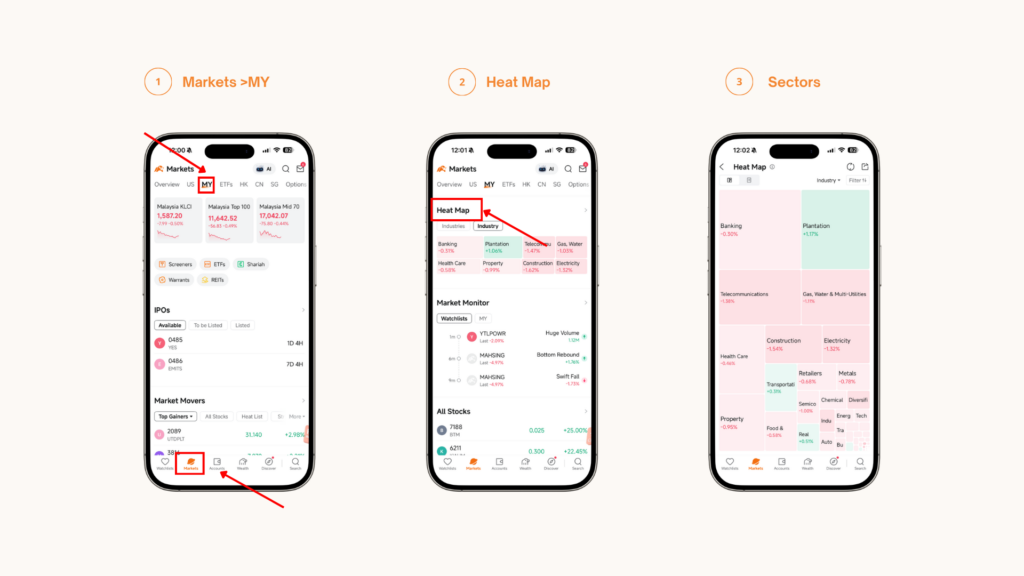
Moomoo’s Heat Map helps you examine the relevant sector and the companies around your stock. A mostly red map suggests that broader market conditions deserve attention, while unusual weakness in one company gives you a reason to look closely at its announcements.
Steps to use Moomoo’s Heat Map:
Follow this with a review of the company’s operating results. For example, Microsoft reported revenue of US$70.1 billion, up 13%, and 33% growth in Azure and other cloud services revenue in its results released on 30 April 2025. These figures gave investors concrete information to assess during the market turbulence that year.
Looking at revenue growth, profitability and management’s outlook helps you assess how the business is responding to the conditions behind the sell-off. You can then decide whether those developments affect the reasons you bought the shares.
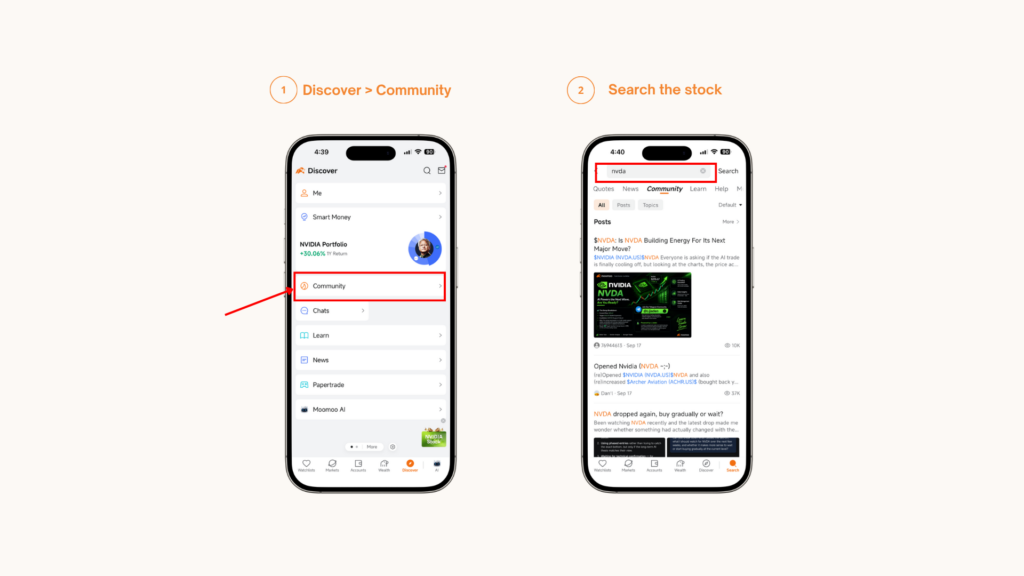
3. Explore the discussion in Moomoo Community
You can expand that research through Moomoo Community, where investors discuss the stocks you may already own. Someone might highlight margin pressure, customer concentration, competition or a detail in the latest results that you have overlooked.
Steps to Use Moomoo’s community tool:
I would look for posts that explain their reasoning and identify the supporting information. A thoughtful discussion can give you a useful question to investigate, especially when it highlights a risk you have not considered. Follow up on those claims through company filings and other primary sources before deciding how much weight to give them.
4. An insider-sale headline deserves a closer look
A headline about a CEO selling shares can quickly attract attention, particularly when the transaction involves a large amount of money. To understand it, check the timing, size and circumstances of the sale. Insider transactions can relate to diversification, personal cash needs or trading plans arranged earlier.
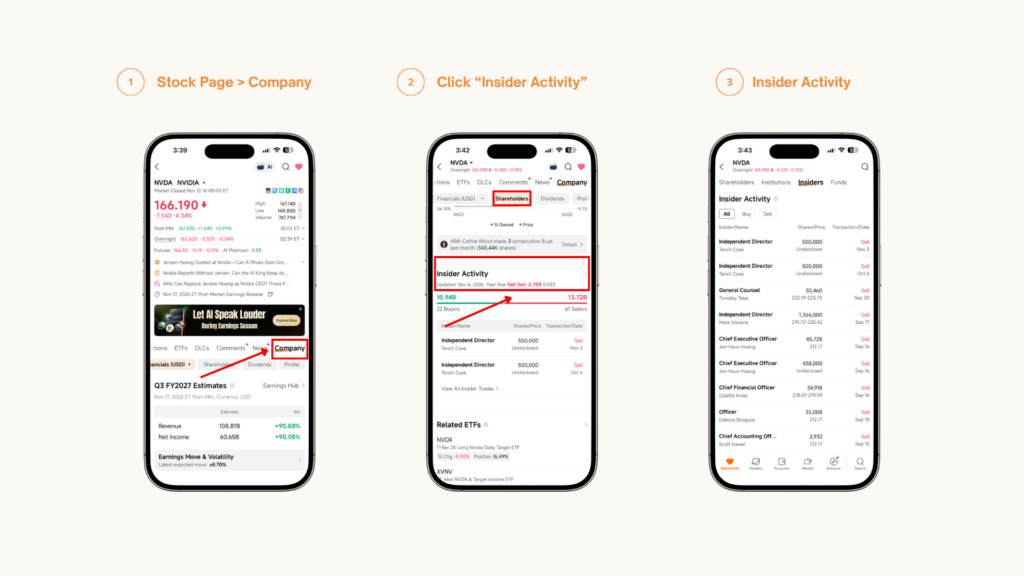
Moomoo’s Shareholders tab lets you examine the available transaction history. Open it and you will find the insider-trading information. Using NVIDIA as an example, you can select Jensen Huang’s name and review his transactions, then examine the holdings information to understand how much ownership remains.
Steps to Use Moomoo’s shareholders tool:
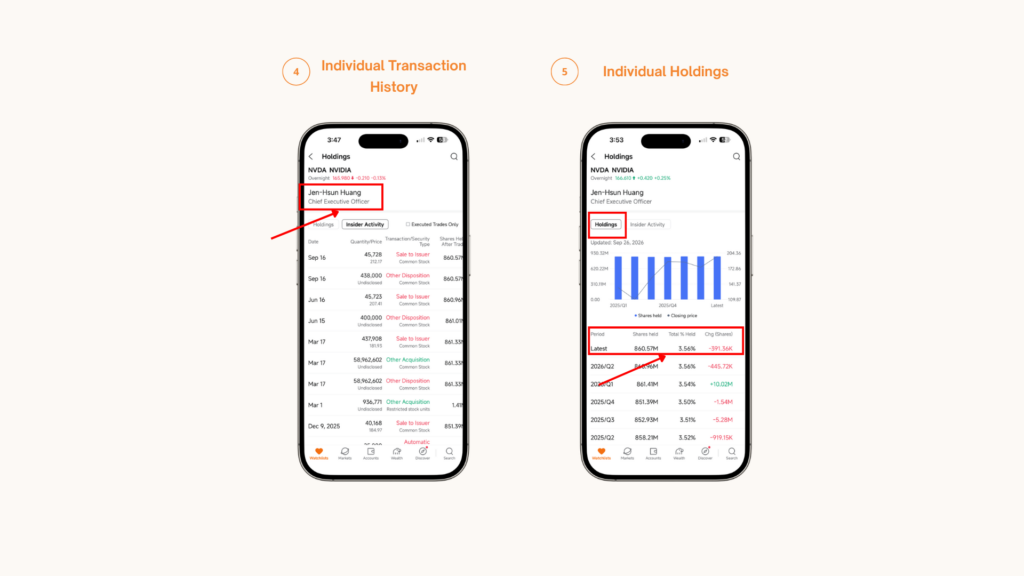
Look at how frequently transactions occur, whether a trading plan is mentioned and how the amount sold compares with the remaining holding. Several insiders selling around the same period may also warrant further investigation. Reading the accompanying disclosures helps you understand the circumstances behind the numbers.
Five Questions To Ask Before Selling a Stock
Once you understand what prompted the review, you can work through the investment itself. I’ll use NVIDIA as a hypothetical holding throughout these five questions so you can see how the different considerations fit together. The examples illustrate a decision-making process and do not describe NVIDIA’s current valuation or disclose my personal portfolio.
1. Is my original reason for buying still valid?
Start by writing down why you bought the stock.
For NVIDIA, your reason might be: “I expect its data-centre business to keep growing profitably, supported by demand for AI computing.” That gives you specific things to monitor, including data-centre revenue, profitability, customer demand and the risks to future growth.
Berkshire Hathaway’s airline exit in 2020 provides a historical example of revisiting an investment case. Buffett explained the decision by saying that “the world has changed for the airlines”. The disruption to travel had changed the conditions behind the investment, leading Berkshire to reassess its holdings.
For your own investment, review the financial results and management’s explanation of the business. Identify which developments support your original expectations and which require closer attention. Over several quarters, this helps you build a clearer view of whether the company is delivering what you expected.
Use Moomoo AI to organise the research
To organise this information, use Moomoo AI and switch on Expert Mode. Give it a research task that connects directly to your reason for owning the company. For example:
“Show NVIDIA’s total revenue and data-centre revenue for the last eight quarters, together with its gross profit margins and main business risks. Present the figures in an interactive chart, explain the changes, and identify the reporting periods and sources.”
Expert Mode can break the question into steps and use market and financial information available within Moomoo to prepare a structured analysis. An analyst-style report helps bring the growth, profitability and risk information together, while an interactive chart lets you tap individual quarters to inspect the figures.
Steps to Use Moomoo’s AI:
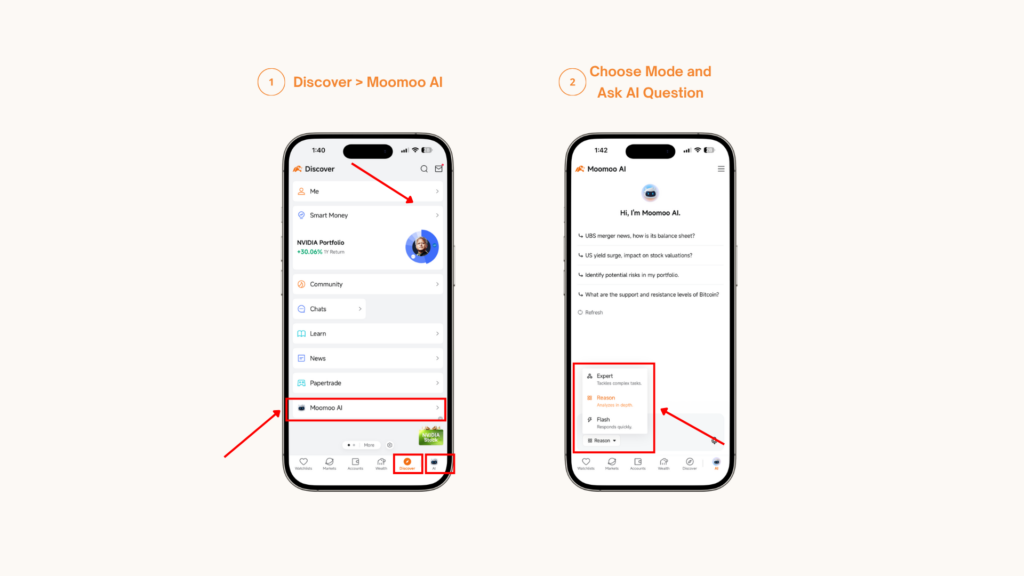
I would use the output to examine how revenue has developed across several quarters, what is happening to margins and how management explains those changes. Also, I look for evidence of weaker demand, competitive pressure or lost customers that could affect the investment case.
Follow the next results through the Earnings page
A quarterly review makes this process easier to maintain. Open the company’s Earnings page and add the next results date to your phone calendar. When an earnings-call replay is available, you can listen afterwards and hear management’s explanation of the quarter.
Steps to Use Moomoo’s Earnings Page:
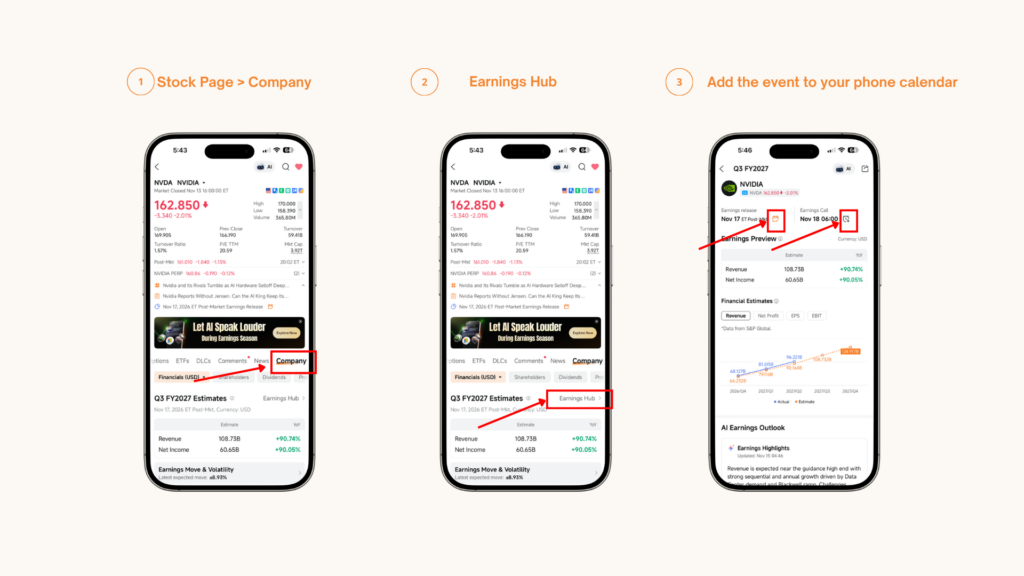
Keep a short note of the measures you plan to check so that each review builds on the previous one. For our NVIDIA example, those measures could include data-centre revenue growth, gross margin and management’s comments on future demand. When the next results arrive, you have a clear starting point for deciding whether your expectations need to change.
2. Does the current share price make sense?
Valuation helps you assess the expectations reflected in the share price. Imagine a kopitiam earning RM100,000 a year, with an owner asking RM1 million for the business. You would be paying ten times its annual profit, which is the basic idea behind the price-to-earnings ratio, or P/E ratio.
At a RM5 million asking price, you would be paying 50 times its annual profit. Justifying that price would require convincing expectations for future earnings growth. You can apply the same reasoning to a listed company by considering how much you are paying for its profits and how those profits might develop.
Open the stock’s Valuation page and examine its P/E information. Start with the company’s historical range, considering how changes in growth, profitability and risk might explain its valuation. You can then compare relevant peers, such as AMD and Broadcom in our NVIDIA example, while accounting for differences between their businesses.
Steps to Use Moomoo’s Valuation:
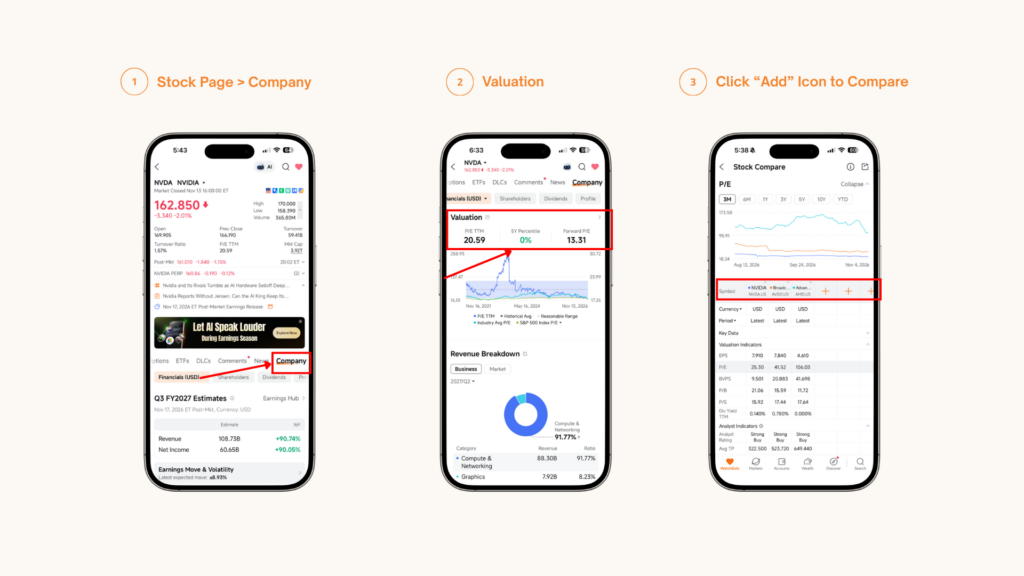
Pay attention to the earnings figures behind the ratios. Acquisition-related accounting charges can reduce reported profit and increase a company’s headline P/E, so reading the underlying results helps explain the comparison.
You can also review forward P/E, which uses expected future earnings and will change as those estimates are revised.
The question I would ask is: “What future performance would justify the price investors are paying today?” Think through what happens if revenue grows more slowly than expected or margins soften.
If the valuation leaves very little room for disappointment, reducing the position may fit your risk tolerance. A valuation that remains reasonable under your expectations can support continuing to hold.
3. Has this position become too large?
Investment returns can gradually change the balance of your portfolio.
Suppose NVIDIA started as 10% of your investments. After outperforming your other holdings, it now represents 35%. Its gains have increased your exposure to the company, and a substantial part of your portfolio’s performance now depends on what happens to that single stock.
To see what this means, imagine NVIDIA falls 50%. At its original 10% allocation, the decline would reduce your total portfolio value by approximately 5%. Once the position reaches 35%, a 50% decline would reduce your portfolio by approximately 17.5%. These calculations assume your other holdings remain unchanged and ignore fees and taxes.
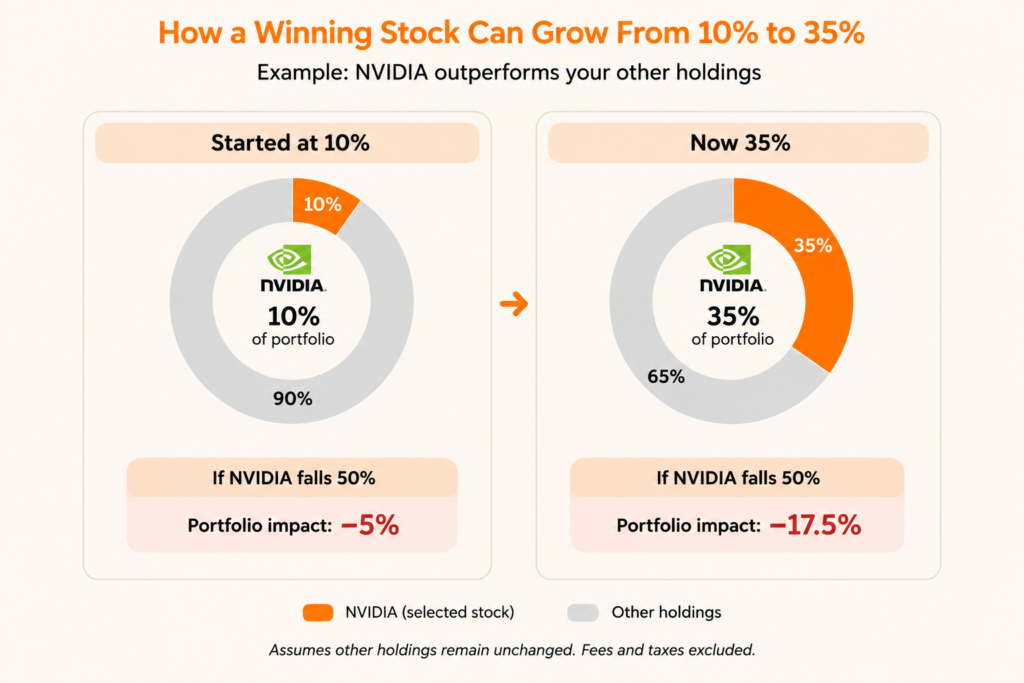
Calculate the position’s weight using its current market value divided by the total value of your investment portfolio, then consider how a disappointing outcome could affect your financial plans. This helps you decide how much exposure you are comfortable keeping as the holding grows.
Use Smart Money to examine reported portfolio changes
You can also explore how large investors’ reported portfolios change through Moomoo’s Smart Money feature. Go to Smart Money, select an institution and examine its holdings across the available reporting periods. Pay attention to each holding’s share of the portfolio and how that allocation has changed over time.
Steps to Use Moomoo’s Smart Money Tracker:
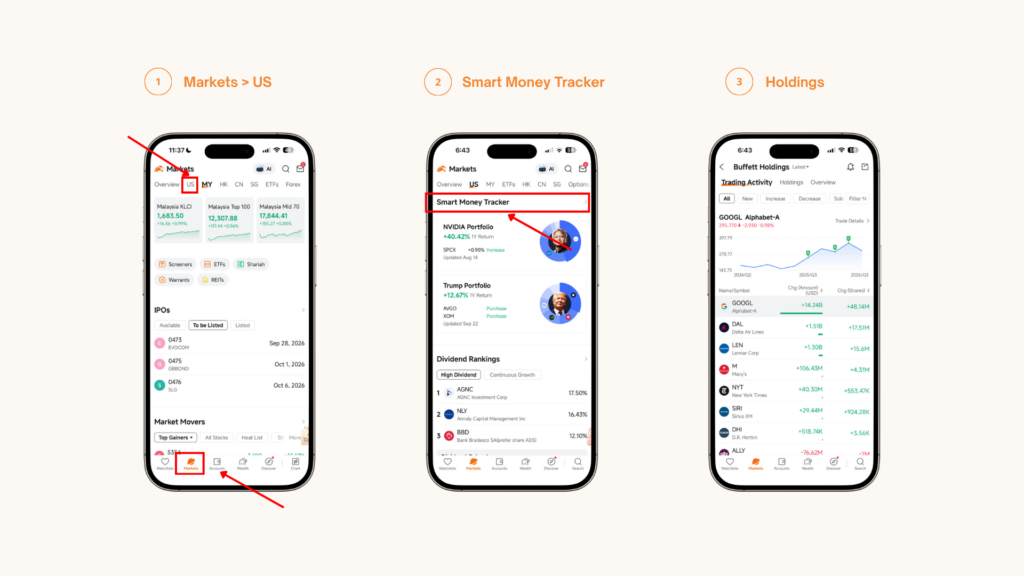
These changes can give you useful questions to investigate around concentration, valuation and capital allocation.
Keep the reporting dates in mind: the quarterly filings behind much of this US holdings information can arrive up to 45 days after quarter-end, and transactions made earlier in the quarter may be older still. The filings also provide limited insight into why an institution changed a position, so further research is needed before drawing conclusions.
4. Have my financial needs changed?
Your investment timeline can change as life moves forward. Perhaps you originally invested for a goal ten years away, and you are now getting married, preparing for a home purchase or planning another major expense. Those commitments can affect how much market uncertainty you are comfortable accepting.
For illustration, a 10% down payment on a RM500,000 property is RM50,000, before legal fees, renovation and other costs. A market decline shortly before the payment date could leave you short of the required amount. Work out how much you need, when the payment is due and how much uncertainty you can afford before that date.
Personally, I prefer to keep money needed within the next year or two away from excessive stock-market volatility. You can sell the amount required for the upcoming expense and review the remaining investments according to their longer-term purpose. This allows you to connect the sale directly to the financial commitment you are preparing for.
A phased sale may suit your plan, although each unsold portion remains exposed to price movements. Build the schedule around your payment deadline and your tolerance for that remaining risk. For a fixed near-term expense, having the money available on time should guide the decision.
5. Is the price trend prompting another review?
Price trends provide another reason to revisit a holding. A moving average shows the average share price over a chosen number of trading days, with the 50-day and 200-day moving averages providing two reference points for examining the trend. Looking at both can help you assess how recent weakness fits into the stock’s longer price history.
On Moomoo, open the stock’s chart indicators, then add the 50-day and 200-day moving averages. Look at how the price has moved relative to these lines and whether the weakness has persisted.
Steps to Use Moomoo’s Moving Average Line:
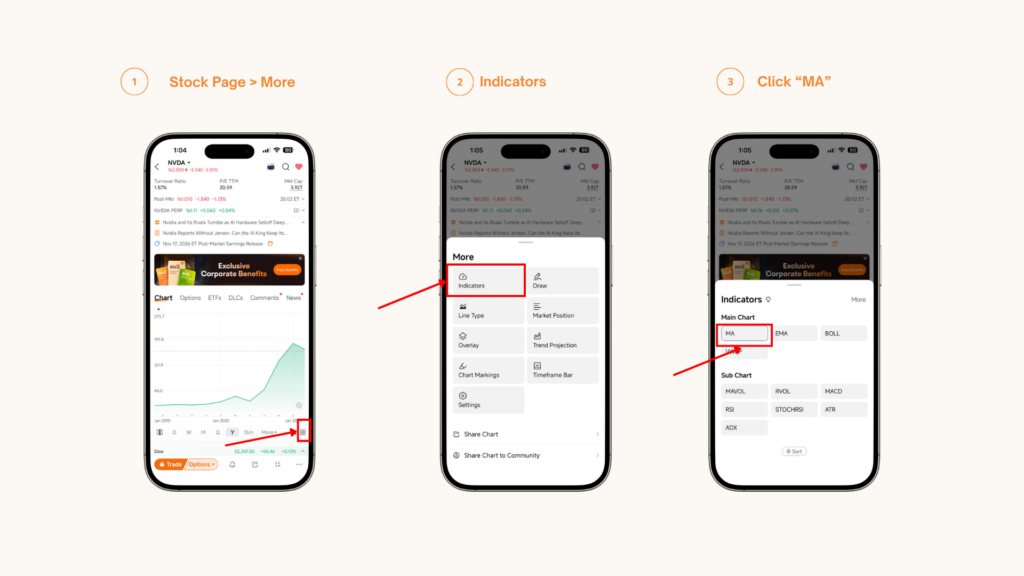
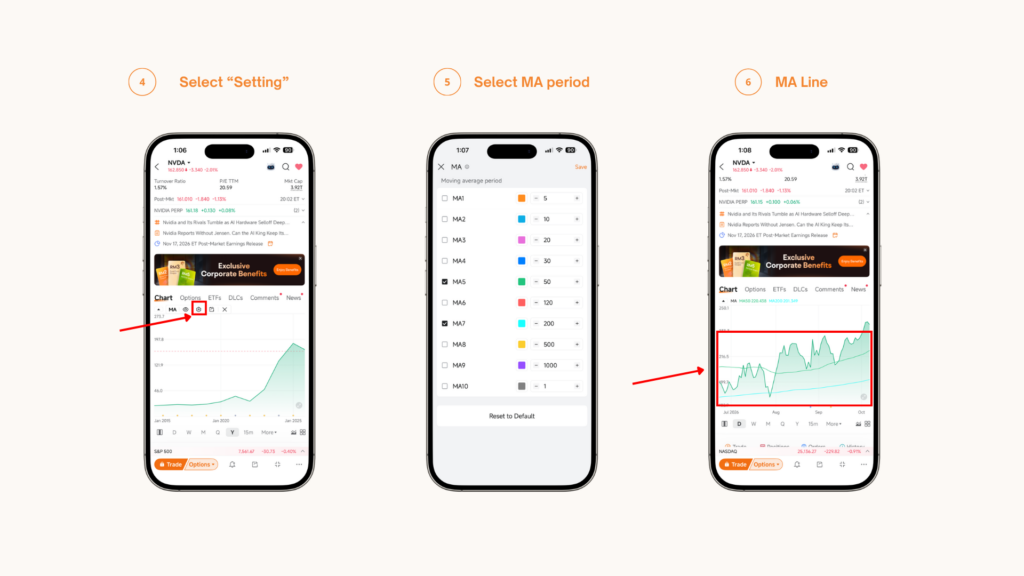
I would use a weakening trend as a prompt to revisit the company’s results, announcements and outlook. Moving-average signals can reverse as prices fluctuate, and several indicators can respond to the same underlying price movement. Consider how much additional information each one contributes, then connect your observations to the investment case and your portfolio plan.
Bringing It Together: Hold, Trim Or Sell?
Once you have worked through the five questions, put your answers together and identify what you want the decision to achieve. You may be comfortable keeping the investment as it is, reducing your exposure or exiting the position.
| Decision | Circumstances that may support it |
| Hold | The investment case remains intact. Valuation is acceptable. Position size fits the plan. Funds remain available for long-term investing. |
| Trim | Reduce concentration. Manage valuation risk. Raise part of the money for another purpose. |
| Sell | The investment case has materially deteriorated. Holding no longer fits the financial plan. |
For our hypothetical NVIDIA holding, suppose the business continues to meet your expectations and its valuation remains acceptable. The position has also grown to 35% of your portfolio, exceeding the allocation you are comfortable keeping. A trim could bring it back within your chosen limit while retaining exposure to the company.
Write down the reason for your decision, the intended position size and what you plan to do with the proceeds. These notes give you something concrete to review later and help you maintain a consistent approach when another holding requires attention.
Which investments should you review first when raising cash?
I would start by examining holdings whose investment case has deteriorated, followed by oversized positions and smaller speculative bets. Core diversified ETFs can come later in that review, depending on their role in the overall portfolio.
Adjust the sequence to your circumstances. The amount required, payment deadline and risk left in your portfolio should guide the final decision. Even a diversified investment needs to be assessed against the date you expect to use the money.
Using Moomoo Alerts And Orders
For Malaysians following US stocks, much of the regular trading session happens at night. Alerts and conditional orders can help you manage a plan while you are away from the screen, provided you understand how the selected order works and which trading sessions it supports.
Let’s use one hypothetical example throughout this section. You bought a stock at US$100, it now trades at US$150, and you have decided that a fall to US$135 should trigger a review or a sell order. The tools below let you specify what should happen when the relevant conditions are met.
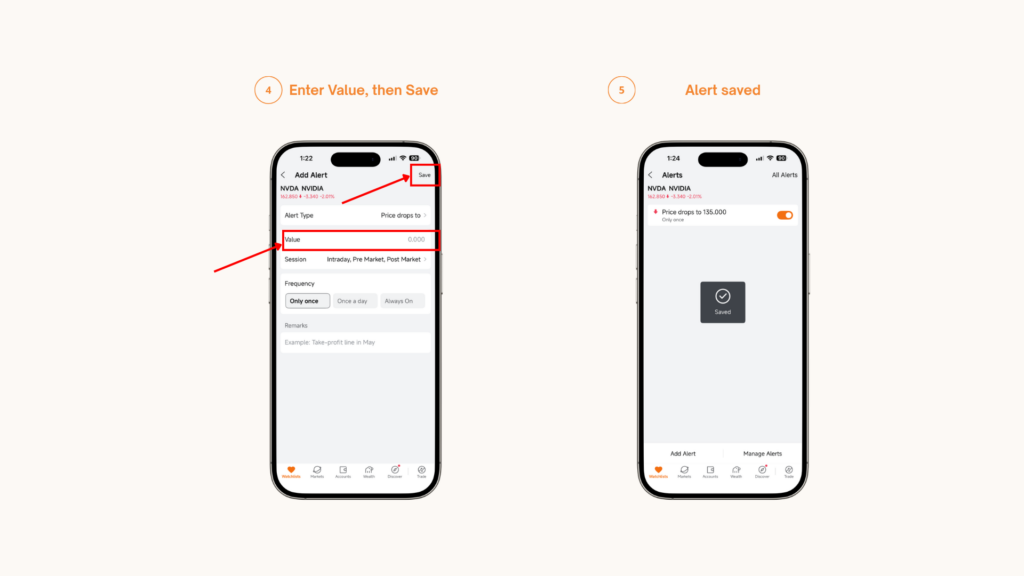
1. Price alert
Open the stock’s price-alert function and set a downside alert at US$135. When the alert condition is met, you receive a notification and can examine what happened before deciding on an action. The alert itself places no trade, so the holding remains exposed to further price movements while you are unavailable.
Steps to Use Moomoo’s Price Alert:
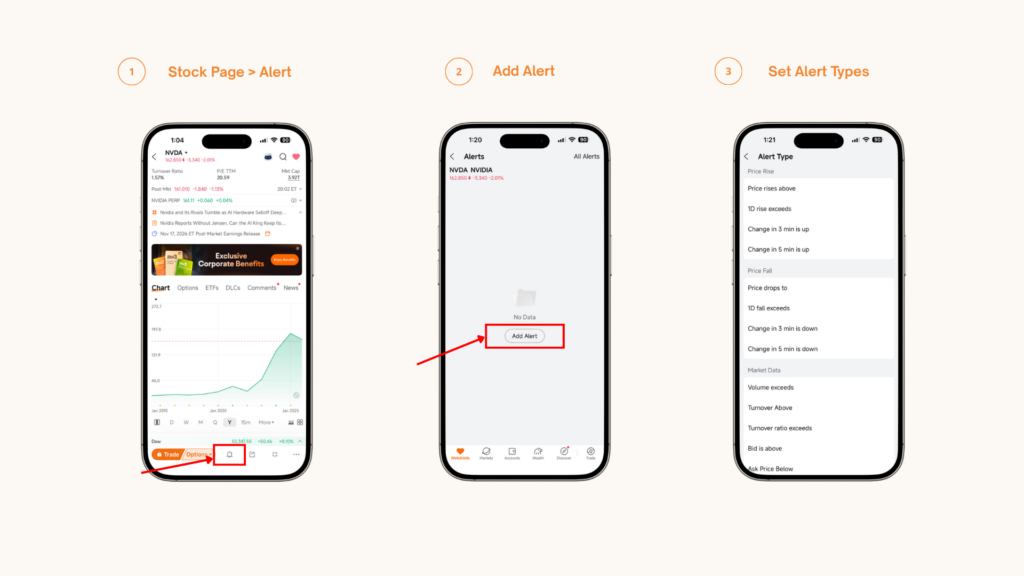
2. Stop-market order
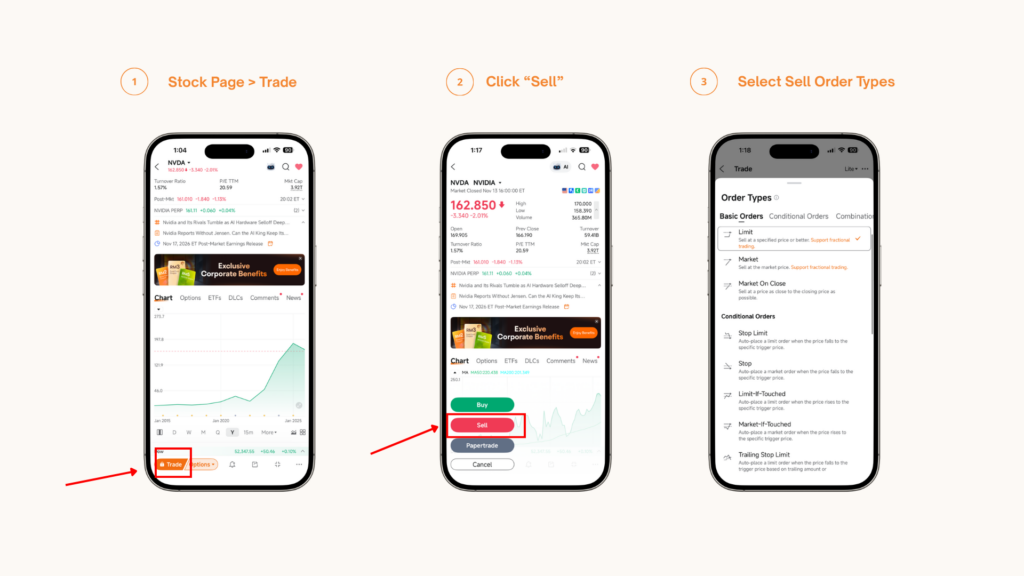
On a supported order ticket, select the stop-market option, enter the quantity and set the stop price at US$135. Once the applicable trigger condition is met, a market sell order becomes active and seeks execution at available prices. The eventual selling price can differ significantly from the stop price.
For example, disappointing news could cause the stock to open around US$120. A triggered market order could execute around that available price, subject to liquidity and market conditions. Review the trigger rules and eligible trading sessions before submitting the order so you understand when it can become active.
3. Stop-limit order
A stop-limit order uses a stop price to activate the order and a limit price to define the lowest acceptable selling price. For example, you could enter a US$135 stop and a US$133 limit. Once triggered, the sell order can execute at US$133 or better.
If the stock gaps down to US$120, the order may remain unfilled because the available price is below your limit. You would continue holding the shares and remain exposed to subsequent price movements. Consider that possibility when deciding whether the limit condition fits your selling plan.
4. Trailing stop
A trailing stop adjusts its trigger as the price moves upwards. Using a simplified 10% trailing-stop example, a stock at US$150 would initially have a trigger around US$135. If the tracked high rises to US$200, the trigger rises to approximately US$180.
The trigger stays at that higher level when the share price subsequently falls. Once triggered, the order seeks execution according to the applicable order rules, with the final selling price subject to market conditions. This lets you set a trigger that follows favourable price movements while defining the size of the reversal that prompts an order.
5. Trailing stop-limit
A trailing stop-limit combines a moving trigger with a limit-price condition. Select the supported order type and review the trailing setting together with the limit-price or offset settings displayed on the ticket. The limit condition determines the acceptable execution price, and the order can remain unfilled when available prices fall below that limit.
For every conditional order, check the quantity, validity period, trigger conditions and supported trading sessions. Consider the stock’s usual volatility as well, because a tight stop can trigger during an ordinary daily price swing. Stop-market orders carry execution-price risk, while stop-limit orders carry the risk of remaining unfilled; those considerations also apply to the corresponding trailing orders.
Steps to Use Moomoo’s Sell Order:
What To Do With The Money After Selling
Once you have sold a position, decide how the proceeds fit into your wider plan. You might be preparing for an expense, waiting for another investment opportunity or adjusting the mix of your portfolio. Giving the money a clear purpose helps you work out where it should go next.
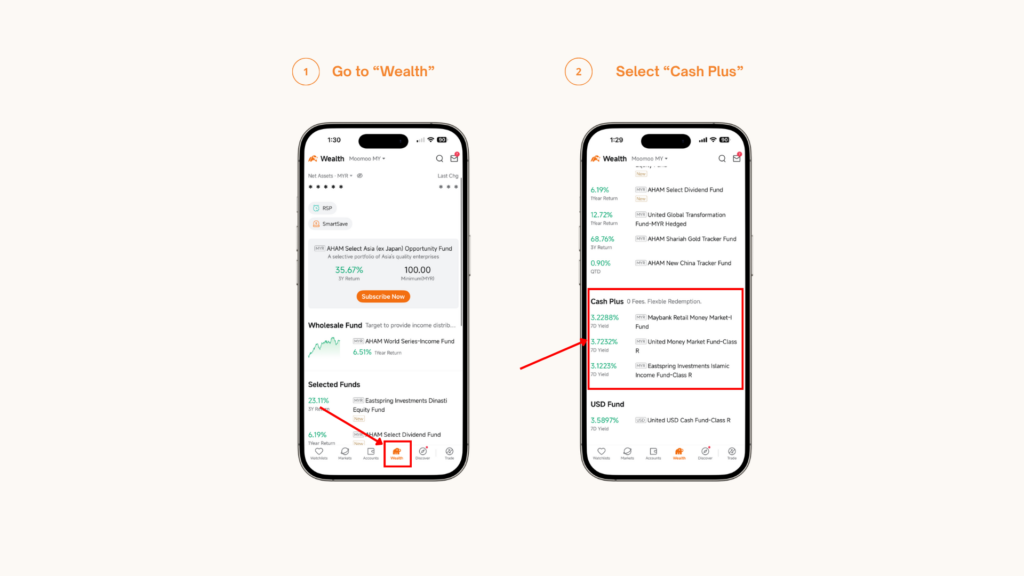
Keep funds available through Cash Plus
Moomoo Cash Plus provides access to money market funds, which you can consider as part of your cash-management arrangements. Open Cash Plus and examine each available fund’s currency, risks, fees and redemption terms. These details matter when you expect to use the money for an investment or an upcoming payment.
Steps to Use Moomoo’s Cash Plus:
Cash Plus returns are not guaranteed, and the underlying fund’s risks still need to be considered. For money earmarked for a wedding or property payment, make sure the access arrangements fit your payment deadline. Review the redemption process early enough to allow for any required processing time.
Research the next opportunity on your watchlist
A stock you have been following should go through the same review before you commit the proceeds. Examine the business, assess the valuation and decide how large the position should be within your portfolio. This gives the potential purchase a clear role in your investment plan.
Once you have identified a price worth reviewing, set a Moomoo price alert at that level. When the notification arrives, revisit the investment case using the information available at that time. You can then decide whether the opportunity still meets your expectations and risk limits.
Add to your diversified core through RSP
You may decide to direct part of the proceeds towards a broad ETF. Moomoo’s Regular Savings Plan, or RSP, supports recurring investments in eligible securities, allowing you to choose an amount and schedule that fit your plan.
Steps to Use Moomoo’s RSP tool:
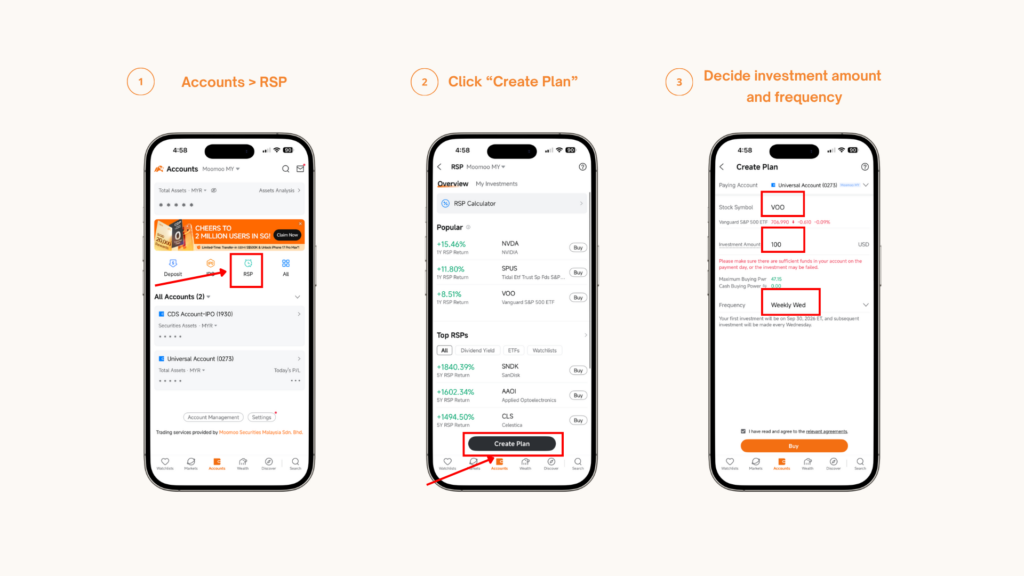
The plan follows the recurring schedule you select, helping you maintain a consistent investing routine. Review the investment periodically to make sure it continues to fit your goals, and remember that recurring purchases remain exposed to the investment’s market risk.
Final Thoughts
A clear selling process helps you understand what each holding is contributing to your financial plan. Review the business, assess the valuation, calculate the position’s weight and consider when you need the money. Price trends can also highlight holdings that deserve another look.
Start with your largest holding and work through the five questions. Write down your decision, the reason behind it and the next event that will prompt a review. This gives you a practical routine to follow as your investments and financial needs develop.
For readers exploring Moomoo, use my referral link to review the available welcome offer. Check the campaign’s eligibility requirements, funding conditions and any additional rewards associated with deposit code ZIET11 before signing up.
Anyways, if you prefer a video version of this article, I have made a video covering the exact same thing – do check it out here! Thanks for reading!

*T&Cs apply. All views expressed in this blog are the independent opinions of Ziet, which are not shared by Moomoo Securities Malaysia Sdn. Bhd. (“Moomoo MY”). No content shall be considered financial advice or recommendation. Moomoo MY links are included in this post, through which referrals are made and I may receive certain commissions. Please contact Moomoo MY for more information.
Share the Wealth
Found this information useful? Share this post with your friends and family to help them stay informed about what’s happening around them. And if you’re not already subscribed, join our community to receive more insightful content directly to your hands.


