
Estimated reading time: 10 minutes
Every time you need to send money overseas, you check Google for the exchange rate. It looks about right. Then you open your banking app, and the screen says: “Zero Transfer Fees” or maybe just a flat RM10 transfer fee. You hit send, feeling like you got a great deal.
But here is the reality. Study showed that Malaysian businesses and individuals lost an estimated RM3 billion in 2023 alone to a fee that never once showed up on a receipt.
If you are a freelancer getting paid in US dollars, a content creator earning from YouTube, an e-commerce seller receiving overseas payments, or a business owner paying foreign suppliers, chances are you have paid this hidden cost too, whether you realize it or not.
In this guide, we’ll explore where these hidden costs come from and the common challenges faced when dealing with foreign currency. And we will also explain how platforms like Airwallex are helping to solve the issues.
TABLE OF CONTENTS
- The Hidden Cost Behind Every Transfer
- Your Business May Already Be International
- The Double Currency Conversion Trap
- What Is Airwallex?
- How Airwallex Global Accounts Work
- Airwallex Foreign Exchange Pricing
- Why International Transfers Can Take Several Days
- More Than an International Transfer Platform
- Final Thought
The Hidden Cost Behind Every Transfer
First things first: The exchange rate you see on Google (which is the mid-market rate) is almost never the rate your traditional bank gives you.
When evaluating a foreign currency transaction, look at both components:
- The visible fee
This may be a transfer fee, service charge, correspondent bank fee or receiving bank fee. - The exchange rate markup
This is the difference between the market rate and the rate offered to you by the bank or payment provider.
The second cost is often harder to identify because it is not always shown as a separate line item.
| Malaysian bank | Fintech (mid-market rate) | |
| Transfer fee | RM10 | ~RM38.50 (0.77% of RM5,000) |
| FX mark-up | ~2.5% built into rate (not shown upfront) | <1% (clearly shown upfront) |
| Effective rate | ~RM5.64 per GBP1 | ~RM5.50 per GBP1 |
| Amount converted | RM4,990 | RM4,961.50 |
| Recipient receives | ~GBP885 | ~GBP902 |
Many people overlook this when comparing international transfers. The advertised fee may be low or even zero but the provider can still earn money by giving you a less favourable exchange rate.
For an occasional personal transfer, the difference may feel irritating but manageable. But for a business moving tens or hundreds of thousands of ringgit every month, it can quietly become a serious operating expense.
Assume a business converts RM100,000 each month and receives a rate that is 2.5% less favourable than the reference market rate. That difference represents approximately RM2,500 per month or RM30,000 per year.
| Malaysian bank | |
| Monthly transfer | RM100,000 |
| FX mark-up | ~2.5% built into rate (not shown upfront) |
| Hidden cost/month | RM100,000 × 2.5% = ~RM2,500 |
| Hidden cost/year | ~RM2500 × 12 months = ~RM30,000 |
That is money that could otherwise be used for:
- Hiring another employee
- Increasing the advertising budget
- Buying inventory
- Improving the product
- Expanding into a new market
This is why business owners should compare the amount received by the beneficiary instead of the transaction fees.
Your Business May Already Be International
Previously, I used to think foreign exchange costs mainly affected importers, exporters and manufacturers shipping physical products across borders.
I realised how wrong I was when I started running my own media business and began reviewing my own transactions.
Although we were not exporting or importing, we were already dealing with several currencies every month.
A typical Malaysian digital business might:
- Receive payments from US customers in USD
- Pay Meta or Google for advertising
- Subscribe to software such as Canva, Adobe or ChatGPT
- Hire freelancers located overseas
- Purchase services from a regional supplier
- Pay for cloud hosting in another currency
- Collect platform revenue from YouTube, Amazon, Shopify or an international marketplace
You do not need an overseas office to become an international business. The moment your income and expenses involve different currencies, foreign exchange becomes part of your cost structure.a starting point, not a conclusion. The question is how to use them properly.
The Double Currency Conversion Trap
One of the most expensive FX problems I came across is being forced to convert the same money twice.
For example, say a US client pays my Malaysian company USD10,000. The money comes into my traditional Malaysian bank account, and it gets converted into ringgit.
At that point, I thought, okay, that’s done. But a few weeks later, I need to pay for USD denominated software subscriptions and digital advertising. So I have to convert that ringgit back into USD.
That means the same money has gone through two conversions:
- USD to MYR when I receive the payment
- MYR to USD when I pay for my business expenses
And each conversion can carry its own exchange rate spread.
That was when I realised I could be losing money simply because I was moving the same money between currencies twice!
The more efficient approach would be to receive USD, keep it in USD and use that balance for future USD expenses. Conversion would only take place when the business actually needs ringgit.
What Is Airwallex?
So, I have always searched for whether there was a better way for businesses to receive, hold and spend money across different countries.
That search is what led me to Airwallex.
Airwallex is a global payments and financial platform designed for businesses that receive, hold, convert, send and spend money in multiple currencies.
The company was founded in Melbourne in 2015 and has since expanded internationally. Its customers and commercial partners have included globally recognised organisations such as McLaren Racing and Arsenal Football Club.
Airwallex (Malaysia) Sdn. Bhd. is regulated by Bank Negara Malaysia as:
- A licensed currency exchange and remittance business under Money Services Business Act 2011
- An approved e-money issuer
- A registered merchant acquirer under the Financial Services Act 2013
One thing I also looked into before using Airwallex was how my money is protected. Airwallex is not a bank, so the balance in your account is not covered by PIDM, which protects eligible deposits held with licensed banks in Malaysia.
Instead, Airwallex’s e-money structure requires customer funds to be ring-fenced. In simple terms, the money is kept separate from Airwallex’s own funds and is not treated as the company’s operating money.
So while the protection structure is different from a traditional bank account, there are safeguards in place to keep customer funds segregated.
How Airwallex Global Accounts Work
One of the Airwallex features I personally found most useful is its Global Accounts.
As a Malaysian business, I can get local account details for receiving payments in supported currencies. So if a US client is paying me in USD, instead of asking them to make a conventional international wire transfer to Malaysia, I can give them USD account details.
Now the money can stay in USD inside my Airwallex Wallet.
For example:
- A customer pays my business USD10,000.
- The funds are received and held in USD.
- I use USD3,000 to pay for advertising and software.
- I convert only the remaining amount that I need in MYR.
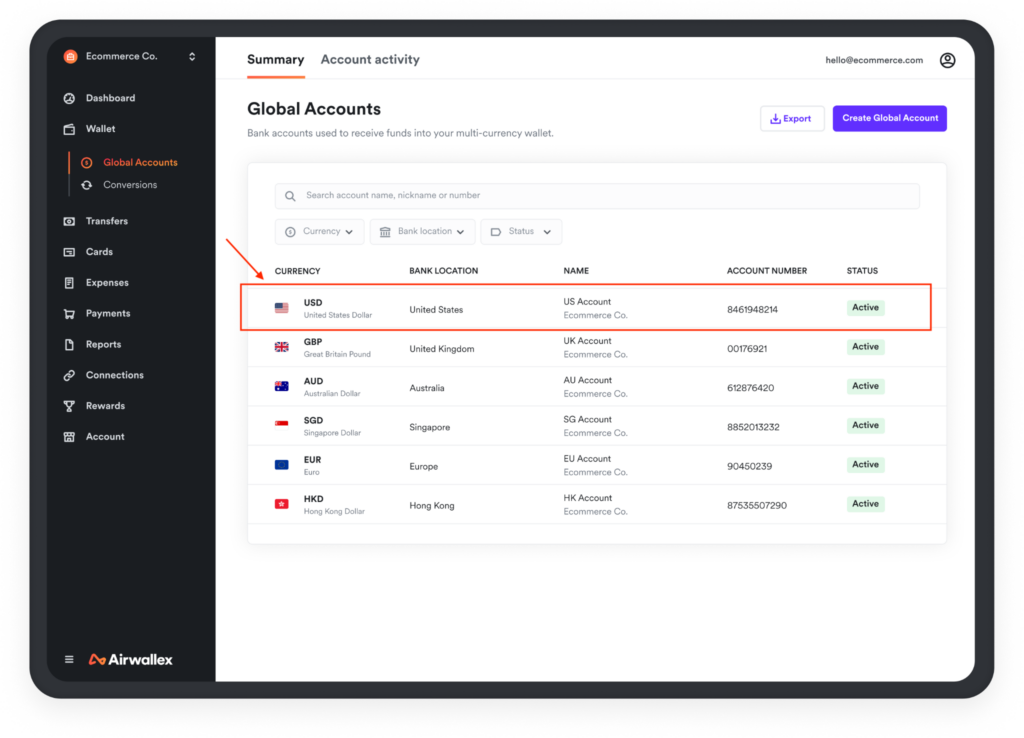
Instead of automatically converting the full USD10,000 into ringgit and later buying USD again, this feature helps me to avoid converting the USD3,000 portion unnecessarily.
This gives my company more control over when conversion takes place.
Airwallex Foreign Exchange Pricing
Airwallex’s FX conversions are priced from approximately:
- 0.4% above the interbank rate for selected major currencies
- 0.6% above the interbank rate for other supported currencies
Here is what the FX rate comparison looks like in practice:
Assuming I’m transferring money to a client in the UK who needs to receive GBP 10,000, here’s how much it would cost me in MYR across different platforms.
| Airwallex | UOB | Maybank | CIMB | |
|---|---|---|---|---|
| Amount client receives (GBP) | 10,000 | 10,000 | 10,000 | 10,000 |
| Rate (1 GBP = XX MYR) | 1 = 5.5661 | 1 = 5.5854 | 1 = 5.5850 | 1 = 5.6275 |
| Amount costs from my account (MYR) | 55,661.00 | 55,854.00 | 55,850.00 | 56,275.00 |
| You lose vs Airwallex (MYR) | – | 193.00 | 189.00 | 614.00 |
So, for the same amount received by the recipient, Airwallex always offers a better FX rate than traditional banks, which costs you less in Ringgit.
Why International Transfers Can Take Several Days
One thing that surprised me after using Airwallex was how quickly some of my international payments could reach the recipient.
Before this, I was used to international transfers taking time, so I never really questioned what was happening behind the scenes.
Then I started looking into how traditional international bank transfers actually work.
Many conventional international transfers rely on SWIFT, a messaging network used by financial institutions to coordinate cross-border payments.
Depending on the payment route, the transfer may pass through one or more intermediary or correspondent banks before reaching the recipient.
Think of it like taking a flight with several connecting stops.
Every additional stop can mean
- more processing time
- more potential fees,
- less visibility over where the payment is,
- more chances of delays because of different banking hours and cut-off times.
What Airwallex does differently is that, where available, it uses local payment networks instead of routing every payment through a traditional multi-bank SWIFT chain.
Airwallex says around 94% of its global transfers are routed through local payment rails, and many transfers can arrive on the same working day.
So instead of your payment taking several connecting flights, it’s more like taking a direct flight whenever the local payment network is available.
Of course, it doesn’t mean every Airwallex transfer is instant. The actual timing still depends on the currency, destination, compliance checks, banking holidays and the recipient’s bank.
More Than an International Transfer Platform
As I looked deeper into Airwallex, I found several features that could help businesses manage different parts of their business finances in one place.
Multi-Currency Corporate Cards
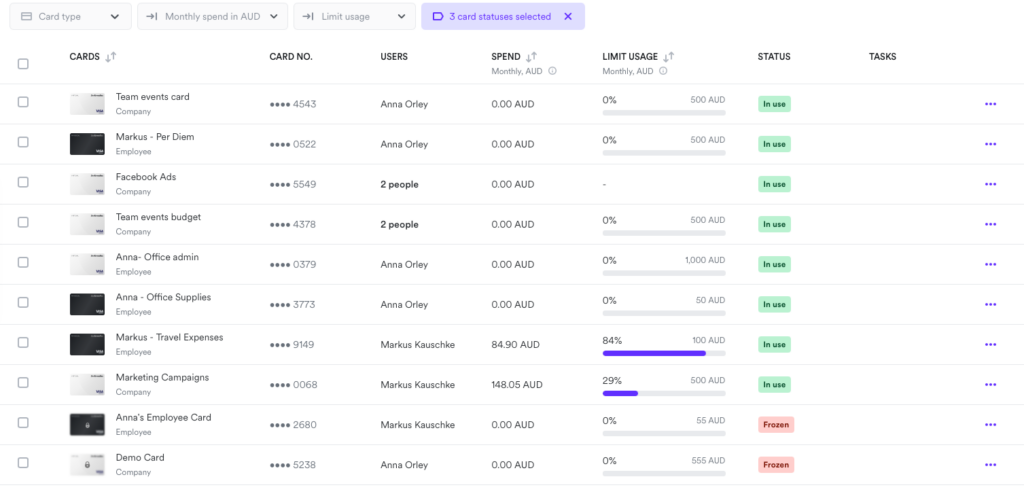
You can also issue virtual or physical company cards to employees or departments.
For example:
- A marketing card for Meta and Google advertising
- A software card for SaaS subscriptions
- A travel card for an employee attending an overseas conference
- A procurement card for supplier purchases
You can assign limits and rules to individual cards.
This is more controlled than giving multiple employees access to one shared company card or asking staff to pay personally and submit reimbursement claims.
Expense Management
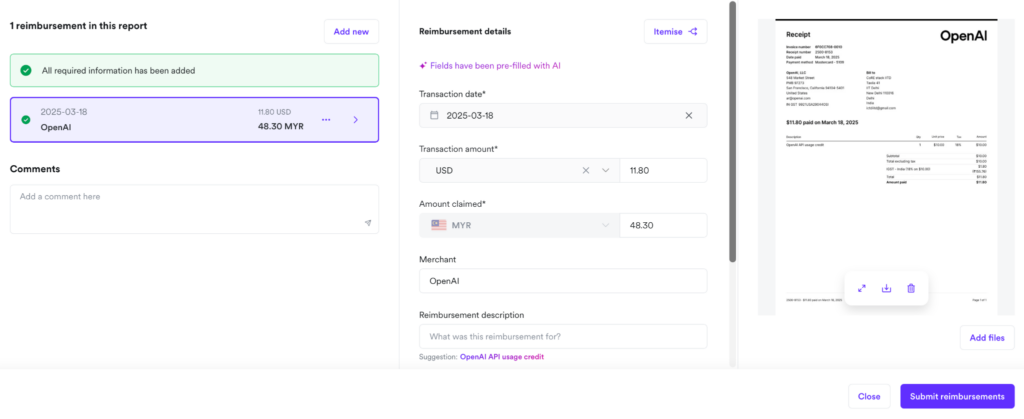
Airwallex’s expense tools are designed to help businesses collect receipts, submit claims and apply approval workflows.
One feature I found particularly convenient is that employees can upload multiple receipts at once. The system AI automatically extracts the relevant details, so there’s no need to enter everything manually.
For a growing team, this can reduce the time spent:
- Chasing missing receipts
- Is revenue growing?
- Identifying which department made a purchase
- Reviewing employee reimbursement claims
- Manually updating expense spreadsheets
Final Thought
After looking at all of this, I think the biggest lesson for me is that efficiency matters.
When you’re running a business, there are so many small financial processes happening in the background. Receiving money, paying for software, running advertisements, reimbursing employees, managing cards and tracking expenses.
Each one might seem insignificant on its own.
But as the business grows, the volume grows with it.
That’s where platforms like Airwallex become important.
For me, a good financial setup is one that makes these processes easier to manage, gives me more control over my money and reduces unnecessary steps along the way.
At the end of the day, that efficiency can make a real difference as it grows.
Anyways, if you prefer a video version of this article, I have made a video covering the exact same thing – do check it out here! Thanks for reading!
Share the Wealth
Found this information useful? Share this post with your friends and family to help them stay informed about what’s happening around them. And if you’re not already subscribed, join our community to receive more insightful content directly to your hands.


