

Estimated reading time: 14 minutes
Most people think financial freedom means quitting your job, starting a business, or suddenly becoming a full-time investor.
But for most working adults, financial freedom actually starts with something much more boring – Your monthly salary.
If you are working a 9-to-6 job, the goal is not to escape work overnight. The goal is to slowly build a system where your money starts working quietly in the background, even while you sleep, work, eat, or scroll TikTok at night.
And honestly, that is how most people should approach wealth. Not through hype. Not through gambling. Not through “all-in” decisions. But through better money habits, consistent investing, and understanding the trade-offs behind every financial decision.
So in this article, let’s break down the 9-6 financial freedom guide.
TABLE OF CONTENTS
- Start With the 50/30/20 Rule
- The Real Trick: Pay Yourself First
- Track Your Net Worth, Not Just Your Salary
- Understand Opportunity Cost
- Use Money to Buy Opportunities
- The Money Formula: Time = Money
- Know the Risk and Reward of Different Assets
- Why ETFs Are Beginner-Friendly
- How to Start Investing
- Regular Savings Plan: Automating Your Investing Habit
- Cash Plus and Money Market Funds
- Sign Up Now to Make Your First Trade (Limited time exclusive rewards!)
- The Real Path for a 9-to-6 Worker
- Common Mistakes to Avoid
- Final Thought
Start With the 50/30/20 Rule
Before we even talk about investing, we need to talk about budgeting.
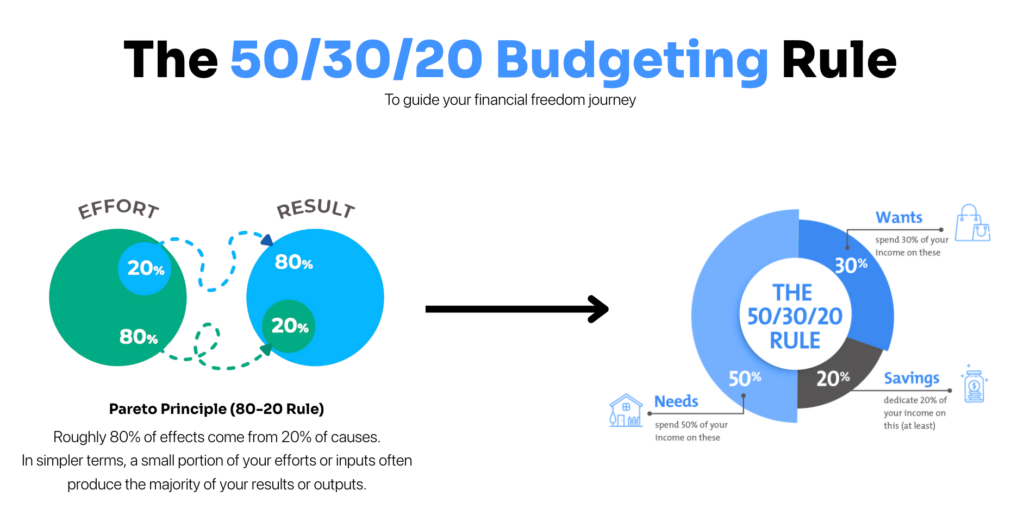
Because no matter how good your investment strategy is, it won’t matter if every month you earn RM5,000 and spend RM5,300.A simple starting point is the 50/30/20 budgeting rule. The idea is:
| Category | Allocation | What It Means |
| Needs | 50% | Rent, food, transport, insurance, utilities |
| Wants | 30% | Eating out, shopping, subscriptions, entertainment |
| Savings & Investments | 20% | Emergency fund, investments, retirement planning |
Is this rule perfect? No.
If you live in KL and rent is expensive, your “needs” may be more than 50%. If you live with your parents, your needs may be much lower.
But the point is not to follow the rule blindly. The point is to have a simple framework. Because once you can see where your money goes, you can finally control it.
The Real Trick: Pay Yourself First
Most people manage money like this:
Salary comes in → pay rent → pay car loan → buy food → go out → pay subscriptions → whatever is left, save.
The problem is, usually there is nothing left. That is why the more useful method is to pay yourself first.
Meaning, the moment your salary comes in, you immediately set aside money for savings and investments before spending on everything else.
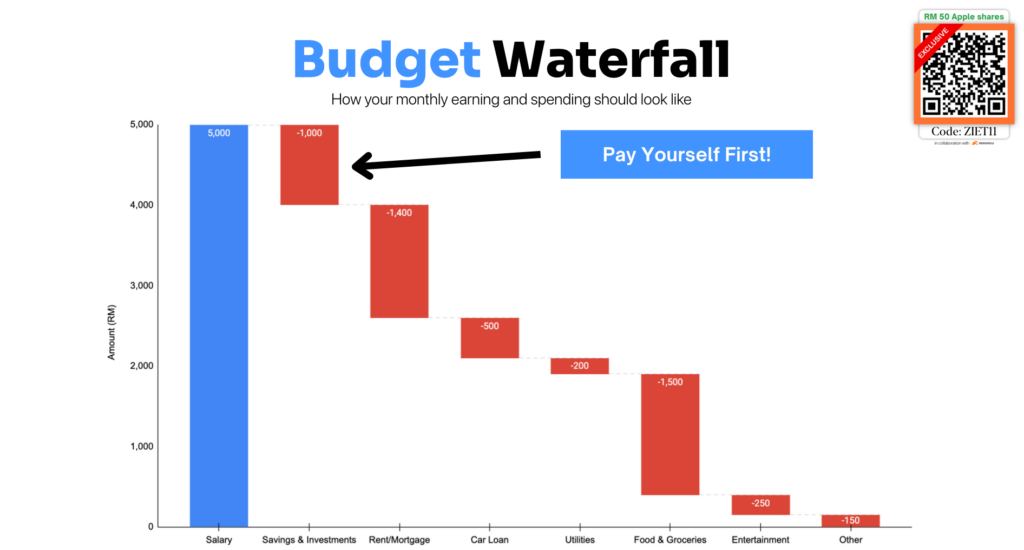
For example, if your salary is RM5,000, your monthly waterfall could look like this:
| Item | Amount |
| Salary | RM5,000 |
| Savings & Investments | RM1,000 |
| Rent / Mortgage | RM1,400 |
| Car Loan | RM500 |
| Utilities | RM200 |
| Food & Groceries | RM1,500 |
| Entertainment | RM250 |
| Others | RM150 |
Notice the key difference. Savings and investments come first, not last.
This one change is powerful because it forces your lifestyle to adjust around your financial goals, instead of letting your financial goals become whatever is left after your lifestyle. Very simple. But very effective.
Track Your Net Worth, Not Just Your Salary
A lot of people measure financial progress by salary.
“My salary is RM4,000.”
“My salary is RM8,000.”
“My salary is RM15,000.”
But salary alone does not tell the full story.
Someone earning RM15,000 but spending RM16,000 is not financially healthy. Meanwhile, someone earning RM5,000 but saving and investing consistently may be building wealth quietly.
That is why you should track your net worth.
The formula is simple: Net Worth = Assets – Liabilities
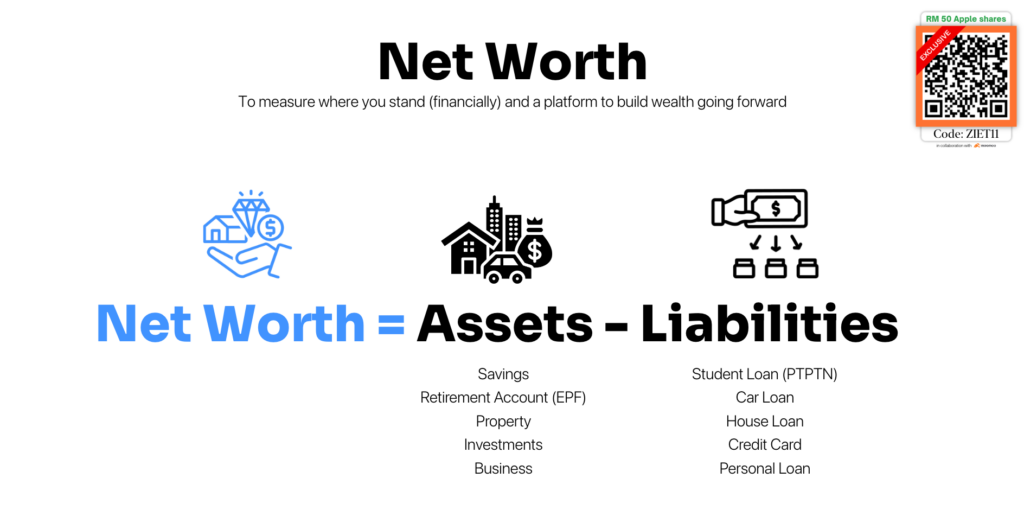
Your assets include things like:
- Savings
- EPF
- Property
- Investments
- Business ownership
Your liabilities include:
- PTPTN
- Car loan
- House loan
- Credit card debt
- Personal loan
This gives you a much clearer picture of where you actually stand. Because the goal is not just to earn more. The goal is to slowly increase your assets and reduce bad liabilities. That is how wealth is built.
Understand Opportunity Cost
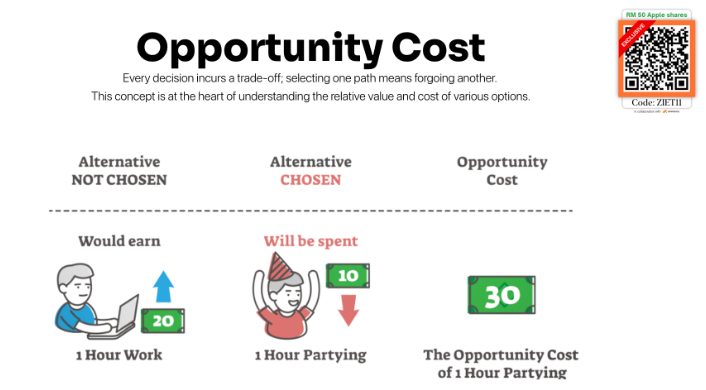
Every financial decision has a trade-off. When you choose one thing, you are giving up something else. That is the opportunity cost.
If you spend RM300 on a night out, that RM300 is no longer available for investing, emergency savings, courses, books, or anything else that may improve your life. This does not mean you should never spend money.
But it does mean you should understand what each decision costs you – not just in ringgit, but in future options.
For example:
- Buying a new phone may cost you RM4,000.
- But the opportunity cost could be one course that improves your skills.
- Or a few months of ETF investing.
- Or an emergency fund buffer.
- Or capital to start a small side hustle.
Once you understand opportunity cost, money becomes more than just “can afford or cannot afford”. The better question becomes: Is this the best use of my money right now?
Use Money to Buy Opportunities
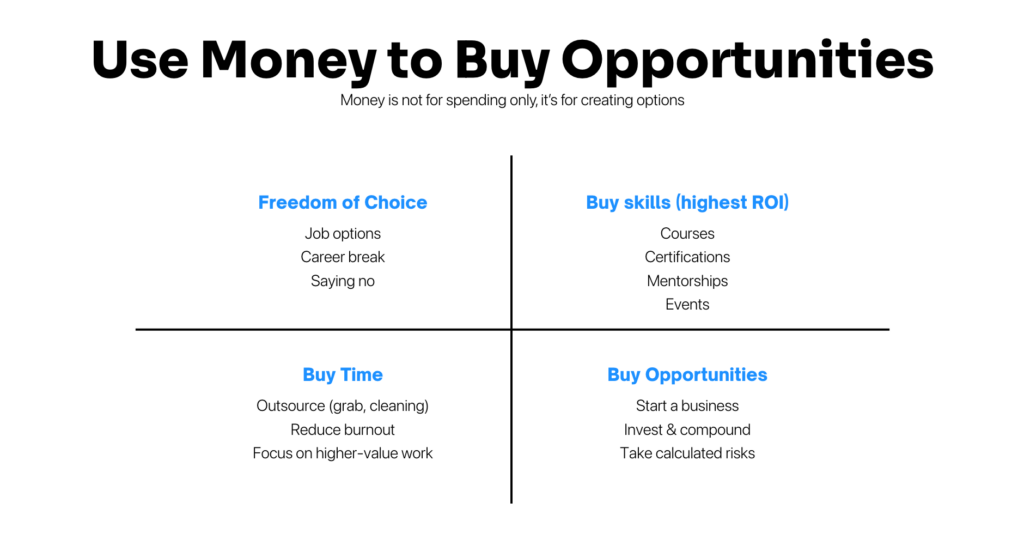
Here’s something I think many people get wrong. Money is not just for spending. Money is for buying opportunities.
That is the real value of money. Not flexing. Not showing off. Not buying things just to prove that you’re successful. Money gives you options. And options are freedom.
There are generally four things money can help you buy.
1. Freedom of Choice
With enough savings, you don’t have to accept every bad opportunity.
You can reject toxic jobs, negotiate better, or take time to think before making big life decisions.
2. Skills
Courses, certifications, mentorships, books, events – these can be some of the highest ROI spending if they help you increase your income.
3. Time
Sometimes, spending money to save time is worth it.
For example, outsourcing cleaning, taking Grab when it saves hours, or paying for tools that reduce repetitive work.
Not because you’re lazy. But because your time can be redirected into higher-value work.
4. Bigger Opportunities
Once you have capital, you can invest, compound, start a business, or take risks that were not available when you were living paycheck to paycheck.
This is why money management matters. Because money is not the end goal. Money is the tool that helps you create more choices.
The Money Formula: Time = Money
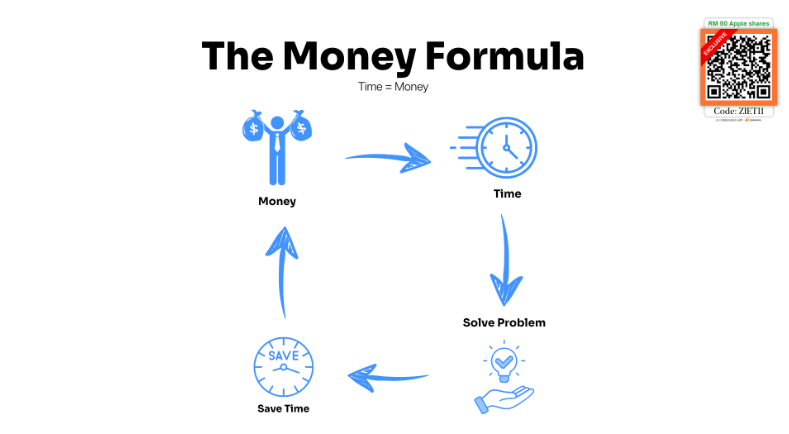
We often hear people say “time is money”. But the relationship is actually deeper than that.
The simple money formula looks like this:
Money → Buys Time → Helps You Solve Problems → Saves More Time → Creates More Money
That’s the loop. The more money you have, the more time you can buy. The more time you have, the more problems you can solve. The more valuable problems you solve, the more money you can make.
This is also why skills matter. If you can solve bigger problems, whether in your job, business, content, sales, finance, tech, or operations, your earning power increases.
And once your earning power increases, you can save and invest more.
So financial freedom is not just about cutting expenses. It is also about increasing your ability to solve valuable problems.
Know the Risk and Reward of Different Assets
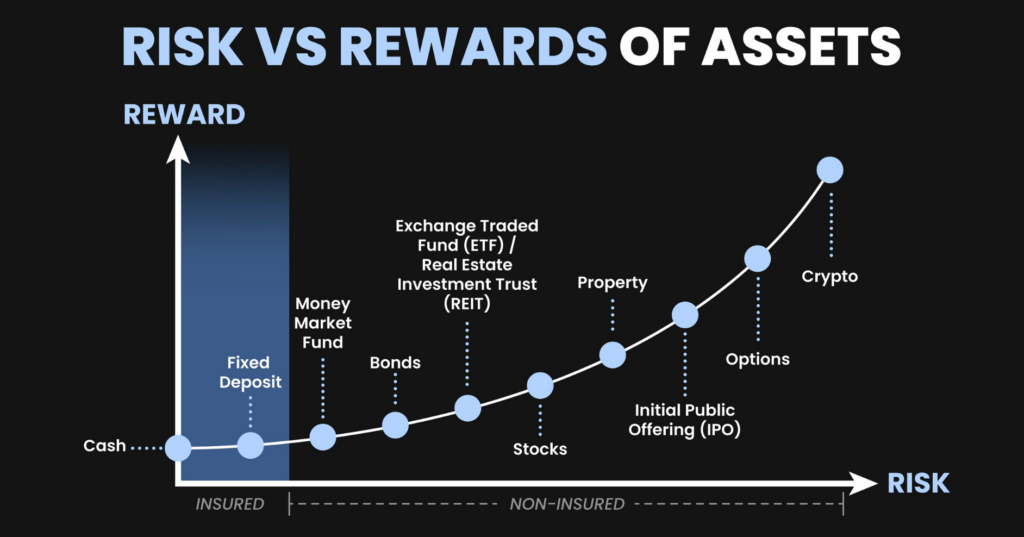
Not all investments are the same. Some are low risk but lower return. Some are higher risk but potentially higher return. Some are liquid. Some are beginner-friendly. Some are absolutely not for beginners.
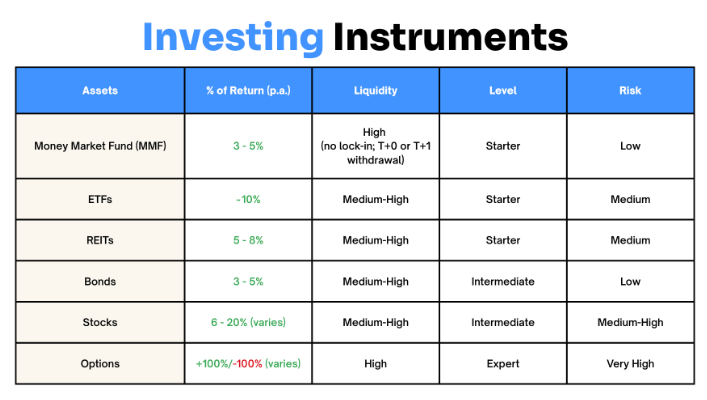
This is not a guarantee of return. It is just a rough way to understand the relationship between risk and reward. Generally, the higher the potential return, the higher the risk.
Cash and fixed deposits are safer, but returns are lower.
Malaysia stocks, US stocks, ETFs, REITs, and property can grow wealth over time, but values can fluctuate.
Options and crypto can move very fast, but they can also destroy capital very fast.
So if you are still new, don’t start at the most complicated end of the spectrum. Start with the basics.
Why ETFs Are Beginner-Friendly
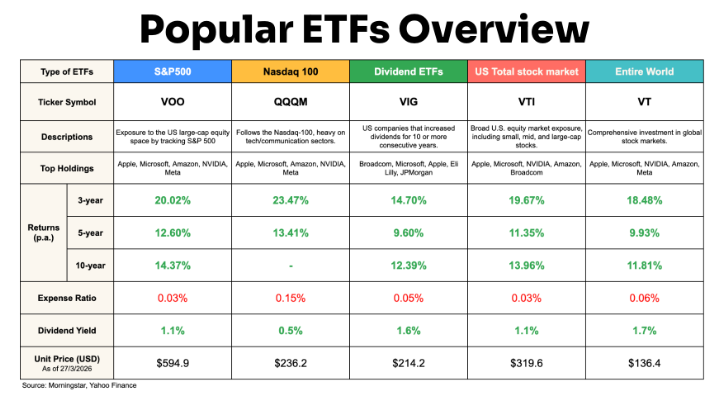
If you are a working adult with a full-time job, you probably don’t have time to analyse 50 individual companies every week.
That is why ETFs can be a good starting point.
An ETF, or exchange-traded fund, lets you invest into a basket of stocks through one single instrument.
For example:
- VOO gives exposure to the S&P 500.
- QQQM tracks the Nasdaq-100, which is more technology-heavy.
- VIG focuses on US companies with a history of increasing dividends.
- VTI gives broad exposure to the US stock market.
- VT gives exposure to the global stock market.
The main benefit is diversification. Instead of betting everything on one company, you spread your risk across many companies.
For example, buying one individual stock like Nvidia means your investment depends heavily on Nvidia’s performance. But buying a broad ETF means you are investing into a whole basket of companies.
That does not mean ETFs cannot fall. They can. But for most beginners, ETFs are often simpler than trying to pick the next big stock.
How to Start Investing
Once you understand budgeting, net worth, opportunity cost, and risk, then only we talk about platforms.
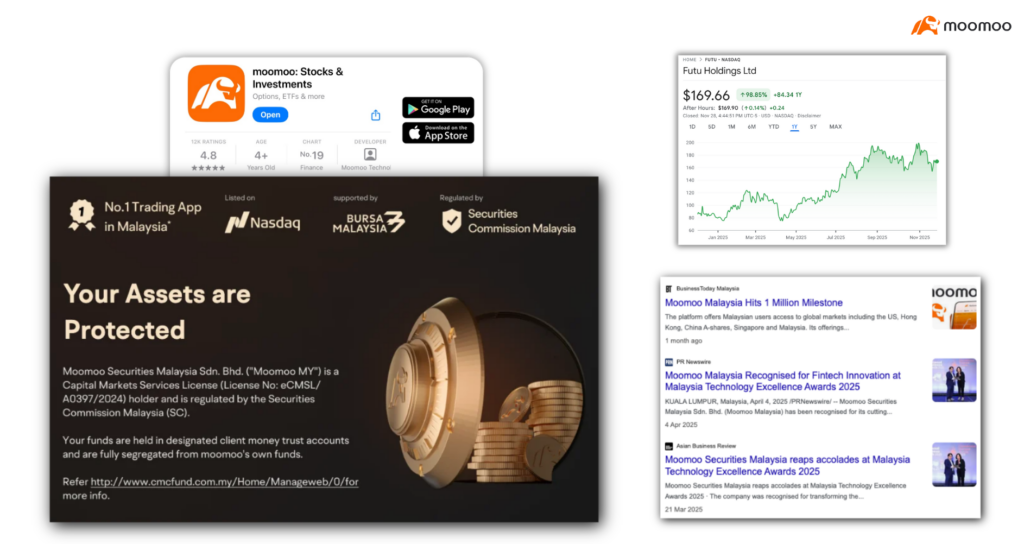
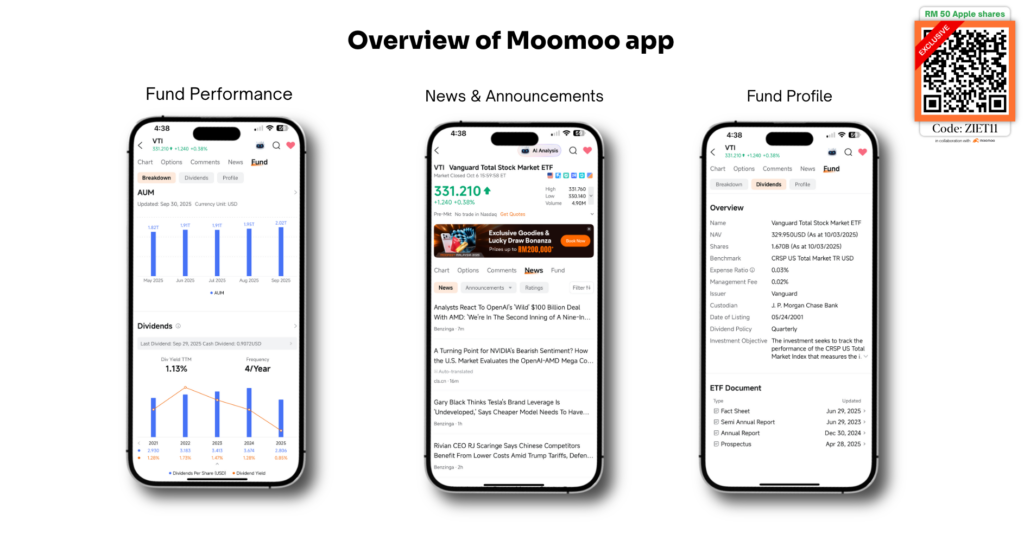
On a brokerage app or trading platform like Moomoo, investors can look at:
- Stock charts
- Fund performance
- News & Announcements
- Fund profiles
- Dividend summaries
- Portfolio holdings
- ETF comparison tools
- Regular Savings Plans
- Money market funds
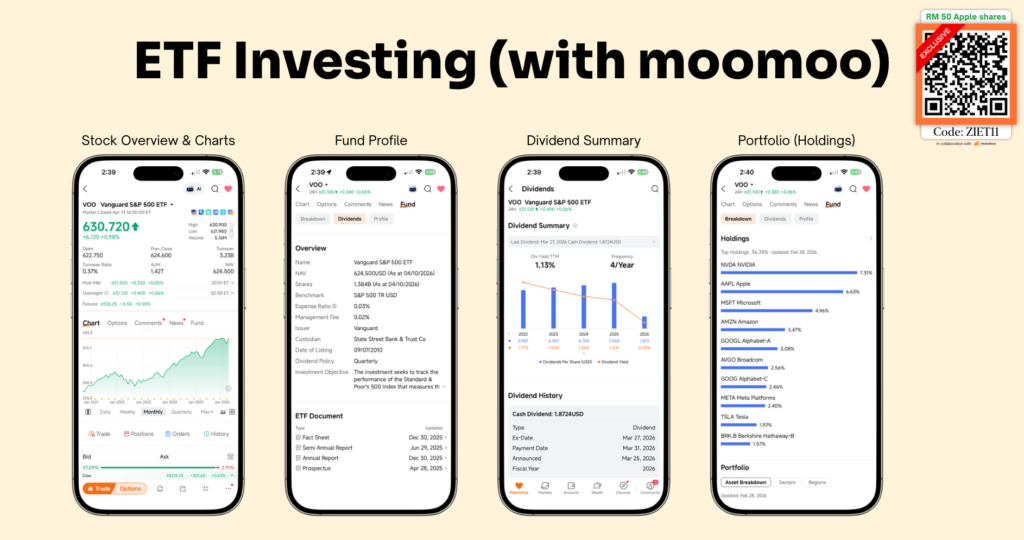
These tools help you understand what you are buying before you invest.
And this is important because many beginners do the opposite. They buy first, then research later. Please don’t.
Research first. Understand first. Then only invest.
Regular Savings Plan: Automating Your Investing Habit
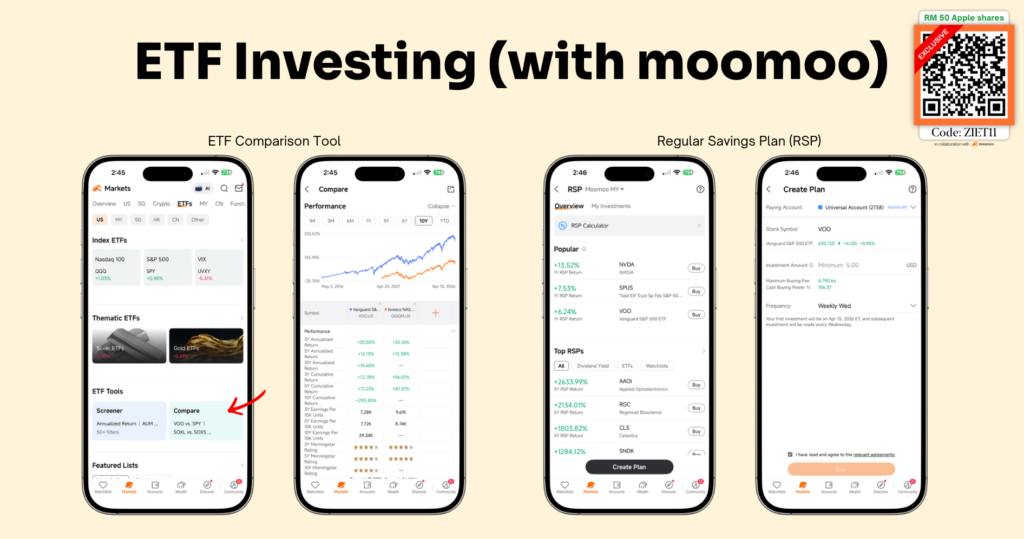
One useful feature for working adults is a Regular Savings Plan (RSP).
Instead of manually deciding every month whether to invest, you can set a recurring plan.
For example:
- Invest RM500 every month into an ETF
- Invest weekly into a selected asset
- Build positions slowly over time
This helps remove emotions from the process. Because in real life, most people are bad at timing the market.
When prices go up, they feel FOMO. When prices go down, they panic. When the market is boring, they forget to invest.
A regular savings plan solves this by turning investing into a habit. Not perfect, but practical. And for 9-to-6 workers, practicality matters a lot.
Cash Plus and Money Market Funds
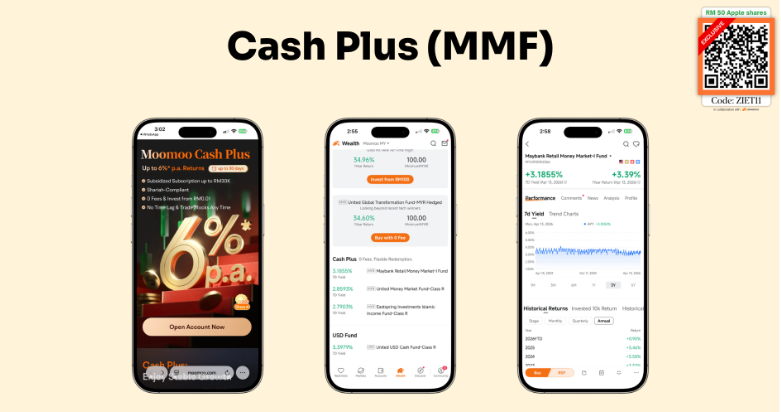
Not all your money needs to go into stocks or ETFs. Some money should stay liquid.
This is where money market funds can be useful.
A money market fund is generally lower risk compared to stocks. It is commonly used for short-term cash parking, emergency funds, or idle cash that you don’t want to leave earning close to nothing.
Moomoo Cash Plus is positioned as a lower-risk product with features like:
- Potential returns around 2.7%–6% p.a. depending on fund and market conditions
- High liquidity
- No lock-in
- Suitable as a starter-level instrument
This can be useful for people who are not ready to invest everything into the stock market yet.
For example, instead of keeping all extra cash in a normal savings account, you can consider placing part of it into a low-risk cash management product while keeping it accessible.
But remember: lower risk does not mean zero risk. Always read the fund documents and understand where your money goes.
Sign Up Now to Make Your First Trade (Limited time exclusive rewards!)

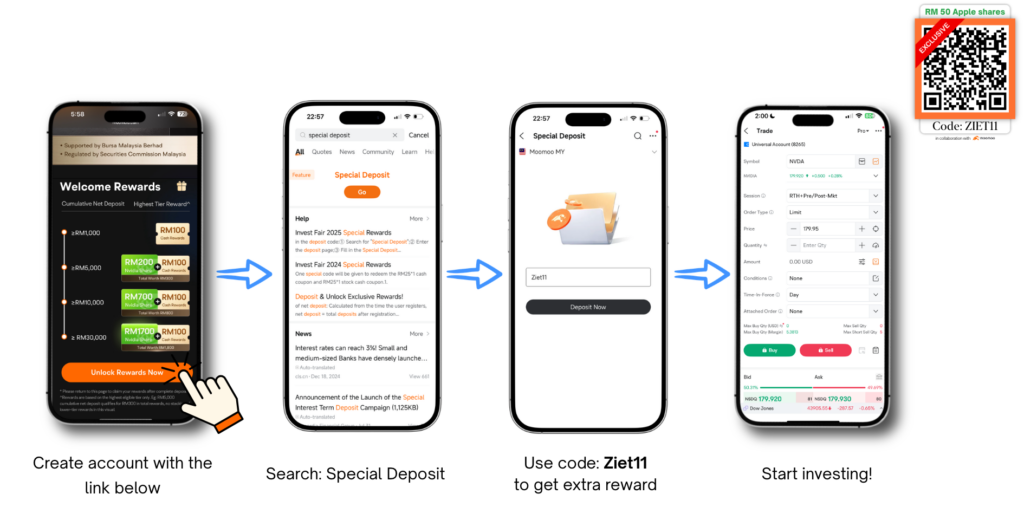
Click here to create an account or use my exclusive code ‘ZIET11’ to unlock all the new users’ rewards!
The Real Path for a 9-to-6 Worker
If I had to simplify the whole financial freedom journey for a working adult, it would look like this:
- Track your income and expenses.
- Use the 50/30/20 rule as a starting guide.
- Pay yourself first.
- Build emergency savings.
- Track your net worth.
- Understand opportunity cost.
- Use money to buy skills, time, and options.
- Start investing with suitable risk.
- Use ETFs or diversified instruments if you don’t have time to pick stocks.
- Automate the process through regular investing.
- Stay consistent for years.
Financial freedom is not built in one month. It is built through repeated boring decisions that compound over time.
Common Mistakes to Avoid
Before we wrap up, here are some mistakes I see beginners make all the time.
1. Investing Before Budgeting
If you cannot manage a RM5,000 salary, earning RM10,000 may not solve the problem. Fix the system first.
2. Chasing High Returns Without Understanding Risk
A product promising high return is not automatically good. Always ask: what is the risk?
3. Putting Everything Into One Asset
Even if you love one stock, don’t let one asset decide your entire future. Diversify.
4. Confusing Trading With Investing
Trading is short-term and requires more monitoring. Investing is long-term and more suitable for most working adults. Know which game you are playing.
5. Waiting for the Perfect Time
The market will never feel perfect. The economy will always have problems. Interest rates will change. Elections will happen. Recessions will come and go.
Start small, learn, and build consistency.
Final Thought
Financial freedom for a 9-to-6 worker is not about quitting your job tomorrow.
It is about slowly building a financial system that gives you more control over your life.
Because one day, the goal is not just to work for money. The goal is to have your money quietly working for you too. Even while you sleep.
*T&Cs apply. All views expressed in this blog are the independent opinions of Ziet, which are not shared by Moomoo Securities Malaysia Sdn. Bhd. (“Moomoo MY”). No content shall be considered financial advice or recommendation. Moomoo MY links are included in this post, through which referrals are made and I may receive certain commissions. Please contact Moomoo MY for more information.
Share the Wealth
Found this information useful? Share this post with your friends and family to help them stay informed about what’s happening around them. And if you’re not already subscribed, join our community to receive more insightful content directly to your hands.


