
Estimated reading time: 15 minutes
Buying your first stock can feel scary.
You open the app or trading platform, see so many buttons, stock prices moving up and down, words like “limit order”, “bid”, “ask”, “settlement”, “time-in-force”… and suddenly it feels like you need a finance degree just to buy one share.
But don’t worry, once you break it down, buying a stock is actually quite straightforward.
You just need to understand what you are buying, how much you are buying, what price you are paying, and when the trade is completed.
So in this article, let’s go through the basics step by step.
TABLE OF CONTENTS
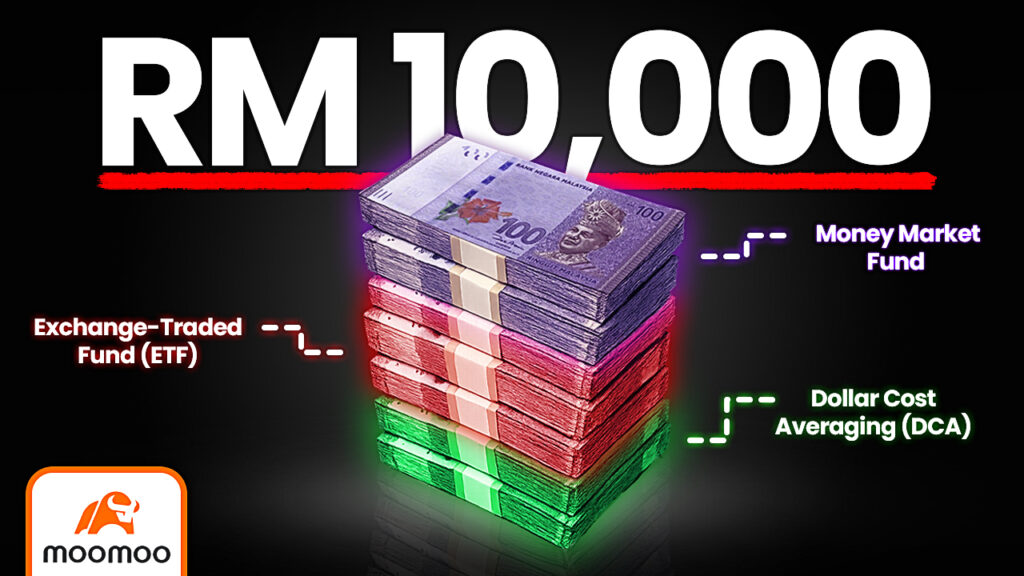
- How to Allocate Your First RM10,000
- New User Sign Up Rewards
- Using Cash Plus for Your Cash Management Layer
- Investing in ETFs for Long-Term Growth
- Building a DCA Strategy with Regular Savings Plan (RSP)
- Common Beginner Mistakes to Avoid
- Practise Before You Risk Your Real Money
- Other Research and Learning Tools Inside moomoo
- A Beginner-Friendly RM10,000 Investment Plan
- Final Thoughts
How to Allocate Your First RM10,000
One common mistake beginners make is treating investing as an all or nothing decision. They either invest everything immediately or avoid investing entirely. A more balanced approach is to split your money based on different objectives.
For example, if you have RM10,000, your RM2,000 can act as a liquidity layer that remains accessible when needed. The remaining RM8,000 can be invested with a longer time horizon, allowing it to benefit from market growth and compounding over time.
This simple structure provides both flexibility and growth potential.
New User Sign Up Rewards.
If you haven’t signed up yet, Moomoo does offer attractive sign-up rewards for new users.

Based on the current campaign details provided, new users may receive free Apple shares with deposits starting from RM3,000, and total rewards can go up to RM1,800.
And if you’re planning to check it out, you can use my special deposit code: ‘ZIET11’. This may unlock extra rewards when you deposit, depending on the ongoing campaign.
Using Cash Plus for Your Cash Management Layer
Before investing, it is important to talk about cash. If you have RM10,000, you probably should not throw everything into the US stocks or MY stocks immediately. You still need some money that is flexible and easy to access.
A simple starting point is to keep around 20% of your RM10,000 as a cash management layer. That means about RM2,000 can be kept in a place where it is still accessible, but has the potential to earn better returns than a normal savings account.
This is where MMFs can be useful.
A money market fund (MMF) is a lower-risk place to park extra cash. It usually invests in short-term and relatively stable financial products such as treasury bills, short-term government bonds, certificates of deposit, and commercial papers.
In simple words, it is not meant to make you rich quickly. It is mainly used for cash management.
For example, you may use it for:
- Emergency cash
- Short-term savings
- Money waiting to be invested
- Cash that you want to keep flexible
Many normal savings accounts offer very low interest. Fixed deposits may offer better rates, but they usually require you to lock in your money for a period of time. MMFs are different because they usually allow you to earn returns while still keeping your money relatively flexible.
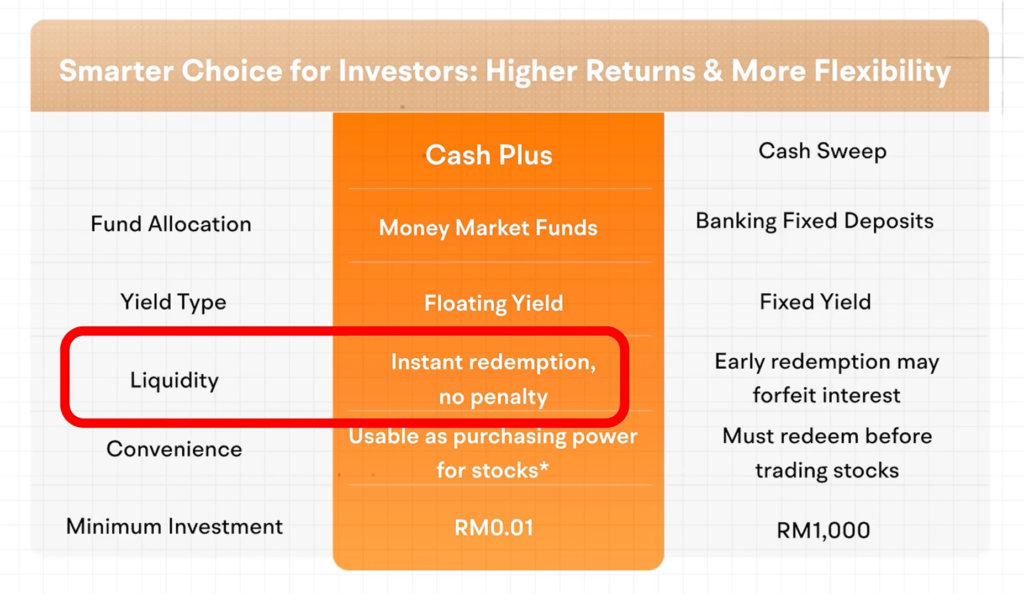
On Moomoo, this feature is available through Cash Plus. Inside Cash Plus, users can explore different fund options, including MYR funds, USD funds, and Shariah-compliant funds. Their Cash Plus offers around 3.5% per year, with boosted rates of up to 6% for new users depending on promotion.
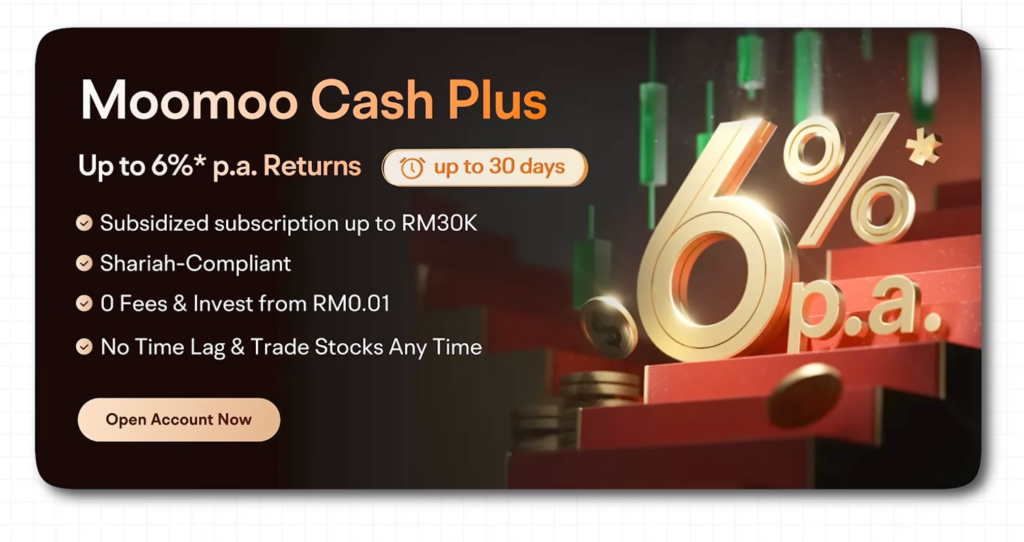
However, it is important to understand that MMFs are not risk-free. So before putting your money into any fund, always read the fund details and understand what you are investing in.
Another thing beginners should note is the yield shown on the app.
Sometimes, you may see a seven-day yield. This number only reflects what the fund earned over the past seven days. It does not mean you are guaranteed to earn the same return forever.
So instead of only chasing the highest number, look at the fund’s longer-term performance, risk level, and whether it matches your needs.
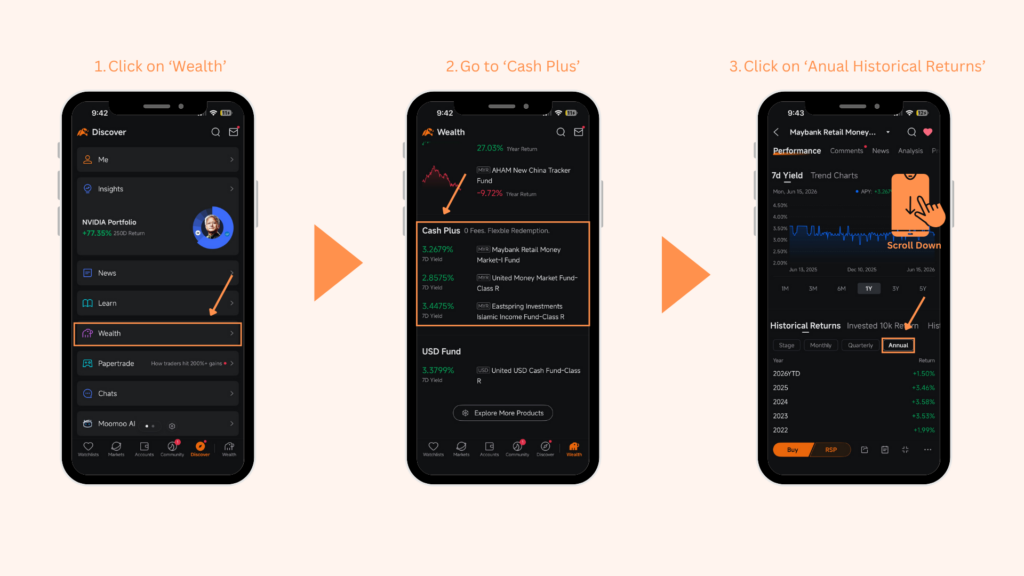
For your first RM10,000, the goal of this RM2,000 cash layer is simple: keep some money flexible while still giving it a chance to earn something.
And for investors seeking Shariah-compliant options, Cash Plus also provides access to funds such as the Maybank Retail Money Market-I Fund and Eastspring Investments Islamic Income Fund.
Investing in ETFs for Long-Term Growth
Once you have your cash layer, the remaining RM8,000 can be used for long-term growth. For beginners, one of the easiest ways to start is through ETFs.
Instead of depending on one company, you spread your money across many companies. Some may do badly, some may do well, but overall, you are investing in the group. That is why ETFs can be beginner-friendly. They reduce the pressure of having to pick the perfect stock.
For example, if you buy an ETF, you are getting exposure to a lot of large companies in the US market. You are not betting everything on one company alone.
Let’s say when you buy S&P 500 like SPY or VOO, you are basically buying a small slice of 500 of the largest listed companies in the US.
So instead of choosing between Apple, Microsoft, Nvidia, Amazon, Meta or Google one by one, the ETF gives you exposure to many of them in one basket.
This matters because individual stocks can be much more volatile. But of course, they are not risk-free. If the whole market falls, they can fall too. But they help reduce the risk of choosing the wrong individual company.
Today, there are many types of ETFs. Some track broad markets like the S&P 500 or Nasdaq. Some focus on gold, bonds, dividends, technology, China, Hong Kong, Malaysia, or other regions.
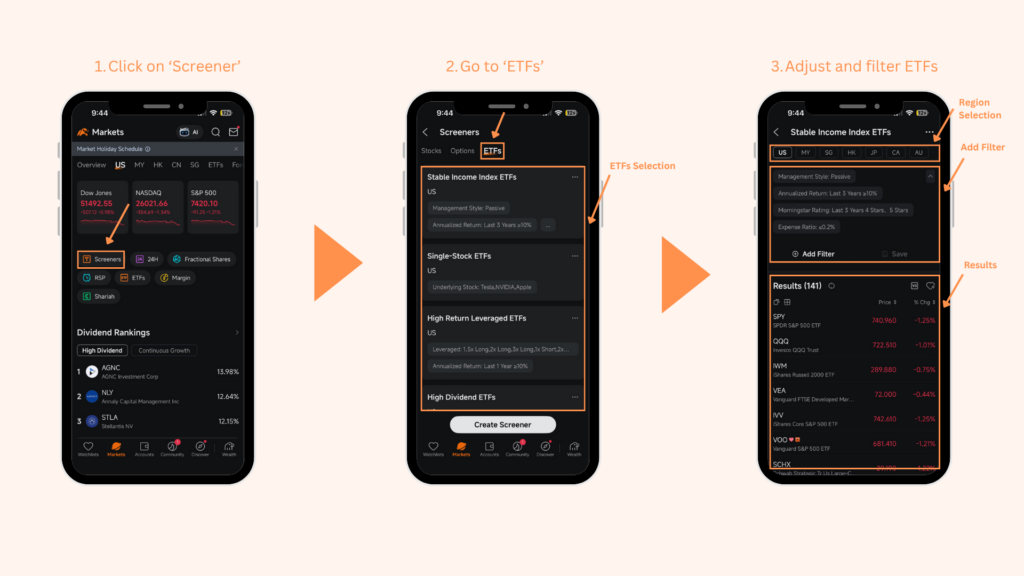
On Moomoo, beginners can search for ETFs directly and compare the details. There is also an ETF screener that allows users to filter based on market, sector, dividends, and other criteria.
This is helpful because many beginners do not know where to start. Instead of randomly searching online, you can use the screener to narrow down your options first.
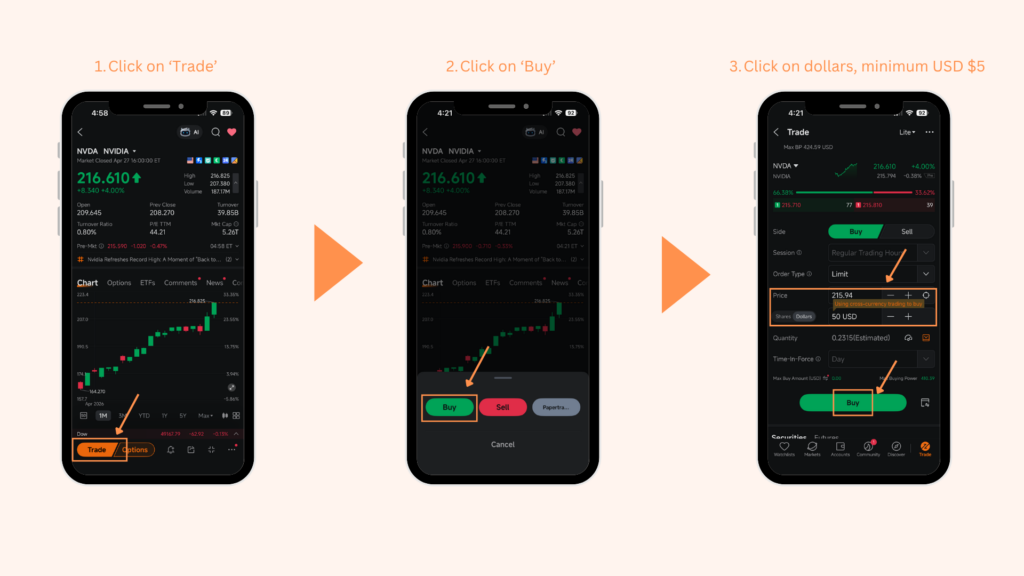
Another misconception is that investing requires a large amount of money.
Thanks to fractional investing, you can start investing in many US-listed ETFs with as little as USD5. This lowers the barrier to entry significantly and allows beginners to start building exposure even with a modest budget.
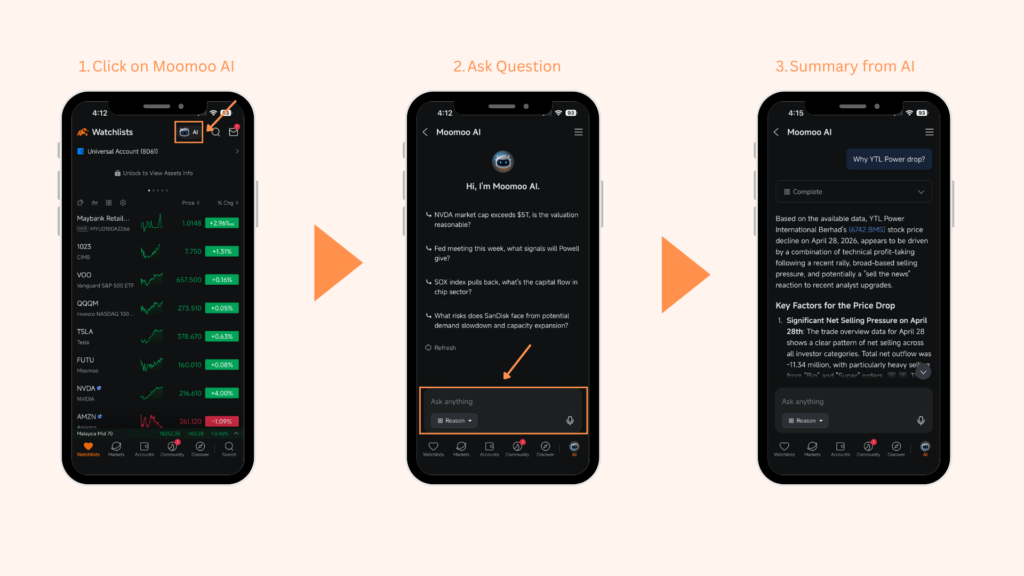
Moomoo AI can also help simplify the research process by summarising market updates and providing quick insights into different ETFs. While these tools can be useful starting points, your investment decisions should always be based on your own financial goals, risk tolerance, and time horizon.
Building a DCA Strategy with Regular Savings Plan (RSP)
Investing your first RM10,000 is a great start, but long-term wealth is rarely built from a single investment decision. The next step is developing a habit of investing consistently.
This is where Dollar Cost Averaging (DCA) comes in. DCA simply means investing a fixed amount of money regularly over time. For example, instead of trying to invest a large amount at the perfect time, you invest RM200, or any amount you are comfortable with every month. When prices are high, your money buys fewer units. When prices are lower, your money buys more units. Over time, this helps smooth out your average buying price.
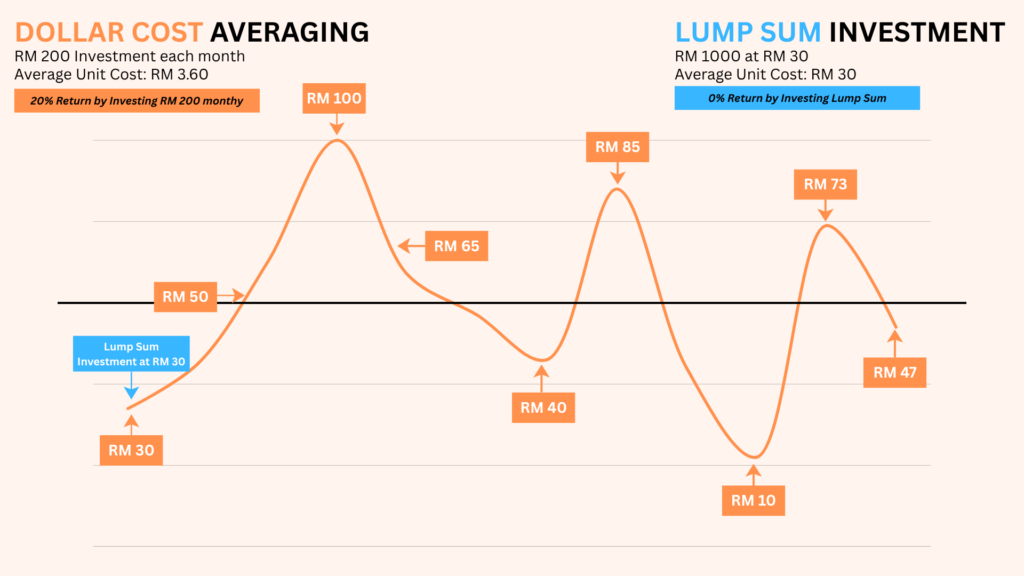
However, the challenge is that consistency is often easier said than done. When markets fall, many people become hesitant and delay investing while waiting for the “right” moment. Unfortunately, that moment rarely feels obvious in real time.
To help solve this problem, Moomoo offers a Regular Savings Plan (RSP), which automates your DCA strategy. You simply choose what you want to invest in and set a schedule whether you want to invest daily, weekly, or monthly. And the minimum investment can be as low as USD5, making it accessible even for beginners.
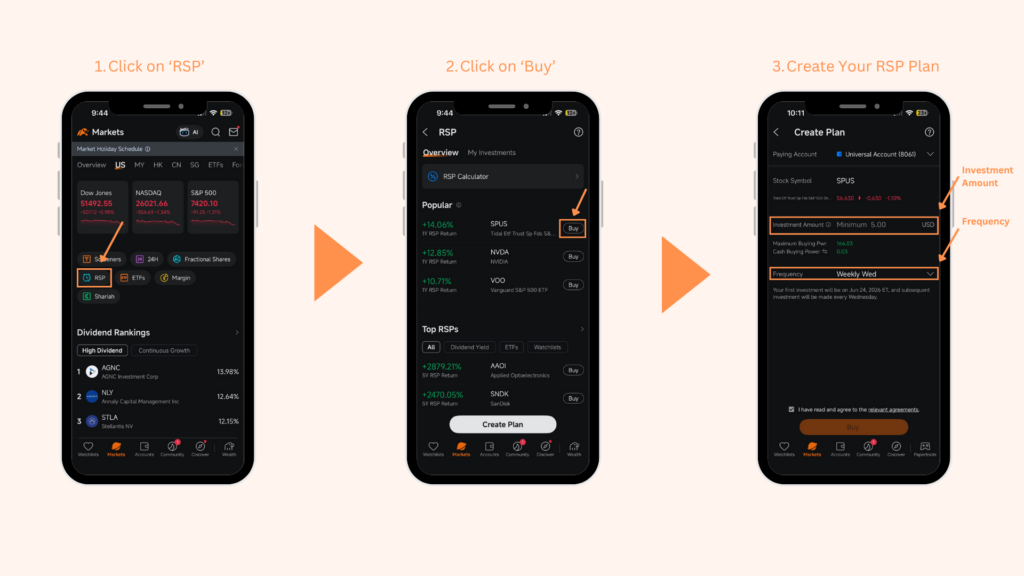
If you’re unsure how much to invest or how frequently to invest, Moomoo‘s RSP Calculator can help. It allows you to visualise different investing scenarios before committing real money, making it easier to build a plan that fits your budget and goals.
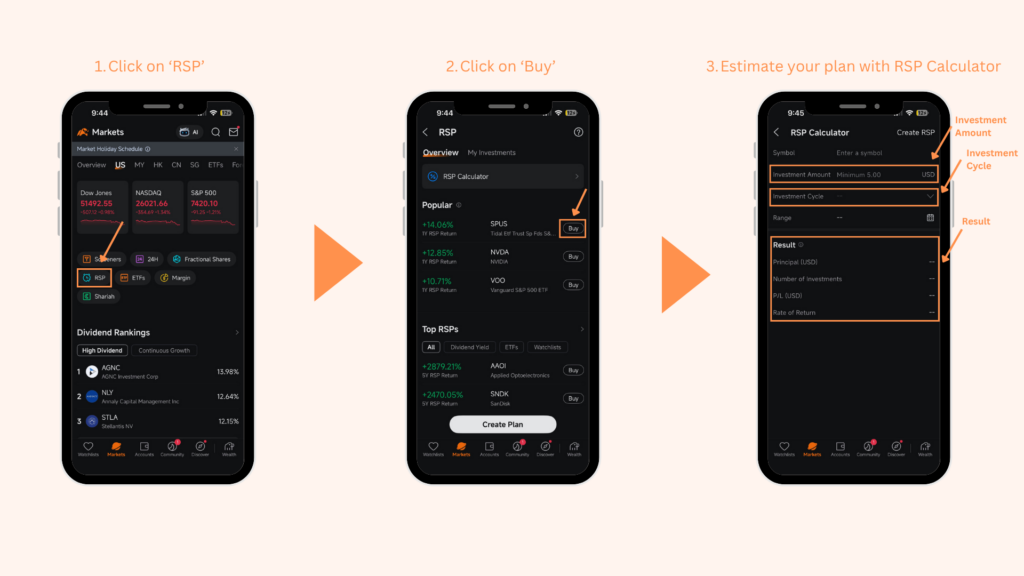
Beyond convenience, the biggest benefit of DCA is psychological. It removes much of the pressure associated with market timing and helps investors stay disciplined regardless of market conditions.
Markets can be emotional. During periods of volatility, even experienced investors can feel uncertain. By automating your investments through an RSP, you create a system that continues working even when emotions tell you to do otherwise.
For many people, this is one of the most effective ways to build long-term investing discipline.
Common Beginner Mistakes to Avoid
Starting your investment journey is exciting, but it’s equally important to avoid some of the mistakes that often derail new investors.
1. Panic Selling During Market Declines
Every investor will eventually experience market volatility. When prices fall, it’s natural to feel uncomfortable. However, selling purely because the market is dropping can turn temporary losses into permanent ones.
Before you invest in anything, take the time to understand why you’re buying it, how long you plan to hold it, and what role it plays in your overall portfolio. When you have a clear reason for investing, it becomes much easier to stay calm during periods of market volatility.
2. Ignoring Fees and Costs
Fees may seem insignificant at first, but they can have a meaningful impact on long-term returns.
Before you invest, make sure you understand the costs involved, including fund expense ratios, trading commissions, platform fees, and currency conversion charges. While each fee may appear insignificant on its own, they can add up over the years and reduce the overall growth of your portfolio.
3. Making Emotional Investment Decisions
It’s easy to feel tempted when everyone online is talking about a particular stock. It’s equally easy to panic when markets turn negative and prices start falling. Unfortunately, making decisions based on hype, fear, or FOMO rarely leads to good long-term outcomes.
Instead, focus on building a process that helps you stay disciplined. This is one reason why strategies like Dollar Cost Averaging (DCA) and automated investing plans such as Moomoo‘s Regular Savings Plan (RSP) can be useful.
By investing consistently on a fixed schedule, you can reduce the temptation to constantly react to short-term market movements and stay focused on your long-term goals.
Practise Before You Risk Your Real Money
Many beginners think they need to start investing immediately. But the reality is, you don’t have to risk real money on day one.
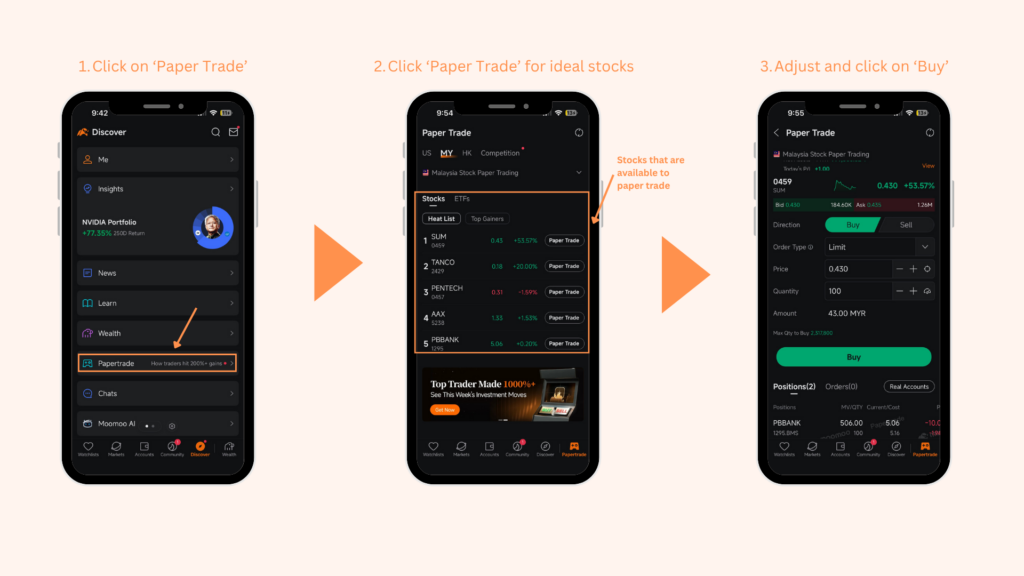
One useful feature inside Moomoo is Paper Trading, which allows you to practise investing using virtual money.
You can test different strategies, learn how placing buy and sell orders works, and get familiar with market movements without risking your actual savings.
Of course, paper trading isn’t exactly the same as investing with real money. The emotions are different when your own money is on the line.
But it gives beginners a safe environment to build confidence, understand how the market works, and learn basic risk management before committing real funds.
Other Research and Learning Tools Inside Moomoo
Moomoo also has research tools that can help beginners learn more before making decisions.
For those looking to analyse companies more thoroughly, Moomoo‘s Stock Screener allows users to filter stocks based on factors such as revenue and profit growth, company size, dividend yields, valuation metrics, financial performance as well as technical indicators.
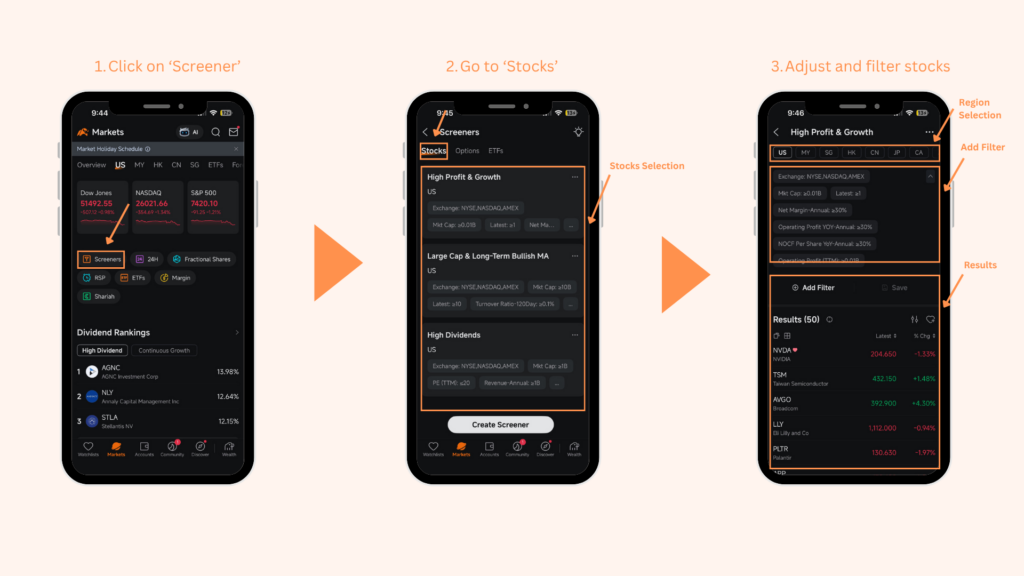
Meanwhile, the Heat List highlights stocks that are attracting significant market attention. While popularity alone shouldn’t determine an investment decision, it can serve as a useful starting point for further research.
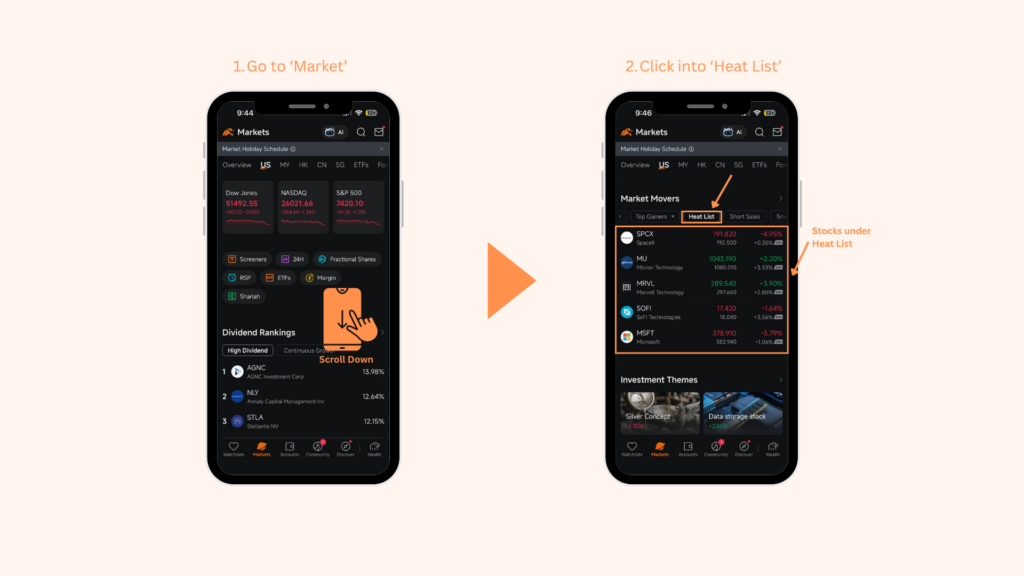
Of course, no tool should replace independent research. Instead, these features are best viewed as resources that help investors organise information and identify potential opportunities more efficiently.
Beyond market research tools, Moomoo also offers educational content that is helpful for anyone still building their investing knowledge. Instead of jumping straight into the market and figuring things out through trial and error, you can access more than 700 educational resources covering topics such as investing fundamentals, ETFs, stocks, market terminology, portfolio building, risk management, and platform tutorials.
This can be particularly helpful for beginners who often feel overwhelmed by unfamiliar terms like P/E ratios, market capitalisation, dividends, or dollar-cost averaging.
And for those who prefer in-person assistance, Moomoo also operates physical stores in locations such as KL Eco City, One Utama, and Pavilion Bukit Jalil, where users can seek guidance and support directly.
A Beginner-Friendly RM10,000 Investment Plan
So how can a beginner think about allocating their first RM10,000?
Here is a simple example. First, keep RM2,000 in a cash management layer.
This can be used for short-term flexibility. It gives you breathing room and prevents you from investing every single ringgit into the market immediately.
Second, allocate RM8,000 for long-term growth. For beginners, this could be through broad-based ETFs instead of individual stocks. Broad ETFs are easier to understand, more diversified, and less dependent on one company.
Third, build a monthly investing habit after that. For example, you could invest 10% of your monthly income. If 10% feels too much, start with a smaller amount. The amount is less important than building the habit.
You can use RSP to automate this process so that you do not need to manually decide every month.
A simple structure could look like this:
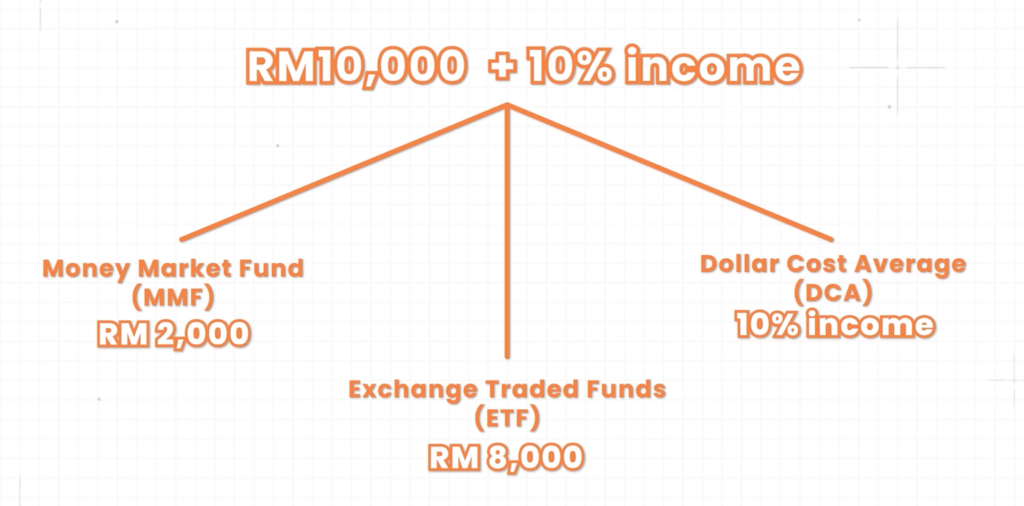
However, this structure is not a universal formula but it demonstrates how investors can balance liquidity, growth, and consistency. The exact allocation should always depend on personal goals, risk tolerance, and financial circumstances.
Final Thought
Your first RM10,000 does not need to be complicated.
A better approach is to keep things simple. Keep some money flexible. Invest some money for long-term growth. Then slowly build a monthly investing habit.
Cash management helps you stay prepared. ETFs help you start investing without relying too much on one company. DCA helps you stay consistent even when the market moves up and down.
And most importantly, learning helps you make better decisions over time.
Before investing, always understand what you are buying, know your own risk tolerance, and make decisions based on your own financial situation.
*T&Cs apply. All views expressed in this blog are the independent opinions of Ziet, which are not shared by Moomoo Securities Malaysia Sdn. Bhd. (“Moomoo MY”). No content shall be considered financial advice or recommendation. Moomoo MY links are included in this post, through which referrals are made and I may receive certain commissions. Please contact Moomoo MY for more information.
Share the Wealth
Found this information useful? Share this post with your friends and family to help them stay informed about what’s happening around them. And if you’re not already subscribed, join our community to receive more insightful content directly to your hands.


